
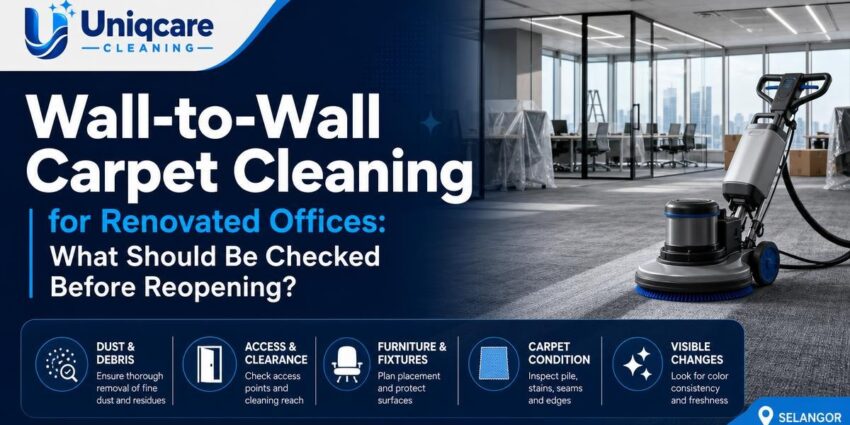
Renovation may be complete, but an office is not necessarily ready to reopen when the builders leave. Fine dust can remain in carpet fibres, furniture may block important areas, and changes in carpet appearance can be difficult to assess after a busy fit-out. A careful review before wall-to-wall carpet cleaning helps office managers in Selangor identify what needs attention, prepare the workspace properly and make a clearer decision about when staff can return.
Why renovated offices need a carpet review before reopening
Wall-to-wall carpet can collect dust and loose debris during drilling, sanding, painting, partition installation and furniture movement. Some particles remain visible on the surface, while others settle deeper into the pile or gather along skirting boards, under workstations and beside access routes. Even when the carpet was protected during part of the work, protection may have shifted or been removed before the final trades finished.
A reopening inspection is not the same as a general visual walk-through. The purpose is to connect the carpet’s condition with how the office will be used. A meeting room with a different traffic pattern from an open-plan area may need a different cleaning priority. Likewise, carpet beneath newly placed cabinets may no longer be accessible, so decisions about cleaning should be made before heavy items are positioned.
The pre-cleaning checklist for a Selangor office
Walk through the office when the renovation team has completed dusty work and loose materials have been removed. Record observations by room or zone rather than relying on memory. Photos can also help compare areas before and after furniture placement, especially where lighting makes carpet colour look different from one part of the office to another.
| Area to check | What to look for | Why it matters before cleaning |
|---|---|---|
| Open-plan work areas | Fine dust, tracked soil, marks from wheeled equipment and clear walkways | These zones usually receive frequent foot traffic and should be assessed before desks are installed. |
| Meeting rooms | Dust around table positions, chair routes, corners and door thresholds | Furniture placement can hide sections of carpet and restrict access for cleaning equipment. |
| Perimeter edges | Residue along skirting boards, walls, glass partitions and built-in cabinets | Edges are easy to overlook during a quick vacuum but may show renovation debris clearly. |
| Entrance routes | Darkened walkways, loose particles, damp marks or transferred material | Entrances often receive the earliest and heaviest post-reopening traffic. |
| Under furniture | Whether desks, cabinets and chairs are already fixed in position | The planned cleaning scope should be clear before access becomes limited. |
| Carpet changes | Flattened pile, colour variation, adhesive marks, fraying or visible seams | Cleaning may improve soil appearance, but physical wear or material changes may need separate assessment. |
1. Check renovation dust in more than the obvious places
Dust is often easiest to see on dark carpet, near windows or where light falls across the floor. However, a clean-looking central area does not mean the whole installation is free from renovation residue. Inspect corners, the edges of temporary partitions, spaces beside power points and the carpet around recently installed doors or cabinetry.
Pay attention to routes used by contractors. A corridor between the lift, storage area and work zone may show more embedded soil than a room that remained closed. If plaster, concrete, wood, paint or packaging materials were present, tell the cleaning provider what was involved. Different residues may require different handling, and not every mark should be treated as an ordinary stain.
Loose dust versus bonded residue
Loose dust and dry particles can often be identified during a close visual inspection and may be reduced through appropriate vacuuming. Bonded residue, paint transfer or adhesive-related marks are different concerns. Avoid aggressive scrubbing or applying household chemicals across a large carpeted area before the material and residue have been considered. An unsuitable product can change the appearance of carpet fibres or make later treatment more difficult.
2. Confirm access before office carpet cleaning begins
Access is one of the most practical issues in a renovated office. A professional cleaner needs a workable route from the entrance to the carpeted rooms, as well as enough space to inspect and clean the floor. Lifts, loading areas, security procedures and building management rules may affect how equipment enters the premises.
Before arranging wall-to-wall carpet cleaning, identify the following:
- Which entrance and lift the cleaning team may use.
- Whether loading or unloading requires approval from building management.
- Where equipment can be placed without blocking fire exits or public walkways.
- Whether power and water access are available where needed.
- Which doors, corridors and rooms must remain open during the work.
- Whether the office has restricted areas, alarm procedures or security check-in requirements.
These details are particularly relevant for offices in shared buildings across Selangor, where the cleaning team may need to coordinate with property management rather than enter directly from a private car park. Clear access planning reduces interruptions and makes it easier to inspect the carpet consistently from room to room.
3. Decide what should happen to furniture
Furniture placement can determine the actual cleaning scope. If desks, storage cabinets or meeting tables have already been installed, some carpet may be difficult or impossible to reach without moving them. Small movable items can usually be considered separately from heavy or fixed pieces, but the final arrangement should be discussed before the appointment.
Do not assume that every item can be moved by the cleaning team. Responsibility may depend on the item’s size, weight, contents and position. Office managers should decide whether furniture will be removed, grouped in one area, left in place or returned after cleaning. Include chairs, pedestals, boxes, loose cables and temporary renovation materials in the planning.
A practical furniture plan
- Mark the rooms and carpeted zones that require cleaning.
- Separate movable items from items that are fixed, heavy or already connected to office systems.
- Clear loose objects, cartons and personal belongings from the floor.
- Keep access paths open between the entrance and each cleaning zone.
- Record any areas that will remain covered by furniture after the work.
- Plan when furniture can be returned, based on the cleaning process and the carpet’s condition afterward.
This approach gives the office a more realistic expectation of what will be cleaned. It also avoids a common misunderstanding: a carpet may be professionally treated, but the result will still depend on whether the cleaner can physically reach every section.
4. Look for visible changes in carpet appearance
Renovation can change how carpet looks even when the fibre has not been heavily soiled. Furniture may leave compressed areas, temporary coverings may create differences in shading, and repeated movement of equipment may produce tracks. Lighting can also make one section appear lighter or darker than another.
During the inspection, compare similar areas rather than judging one patch in isolation. Look at carpet in open areas beside sections that were covered. Check the direction of the pile by viewing the floor from different angles. Note any flattened sections, pulled loops, exposed seams, fraying or colour changes before cleaning begins.
Cleaning can address soil and some marks, but it cannot be assumed to reverse every physical or colour change. A professional assessment should distinguish between removable residue and conditions related to wear, fibre damage, fading or installation. Taking notes before reopening helps prevent uncertainty about whether a change was present before or after cleaning.

Wall-to-wall carpet is not judged only by its central surface. Thresholds at doorways can collect material from renovation work and outdoor traffic. Edges near walls may hold dust that ordinary office vacuuming misses. Areas around lift lobbies, pantry entrances and printer zones may also receive more soil than less-used rooms.
Inspect the carpet where it meets other floor types, such as tile, vinyl or hard flooring. Check whether transition strips are secure and whether carpet edges are lifting or exposed. If the renovation involved removing old flooring or adhesive, clarify whether any glue removal was part of the project or remains a separate issue. Carpet glue removal is a different service requirement from routine office carpet cleaning and should not be treated as an ordinary surface mark.
6. Separate cleaning needs from renovation defects
A reopening checklist should identify which observations are cleaning concerns and which should be referred back to the contractor, landlord or fit-out team. For example, loose dust is a cleaning issue, while a damaged seam, lifted edge or installation defect may require repair or inspection by the relevant party.
| Observation | Possible next step |
|---|---|
| Dry dust or loose particles | Include the area in the planned office carpet cleaning scope. |
| Unknown liquid or chemical mark | Record the location and explain what was used or spilled, if known, before treatment. |
| Paint or adhesive residue | Request an assessment rather than applying an untested chemical. |
| Raised edge or open seam | Document it and ask the installer, landlord or responsible contractor to review it. |
| Flattened or shaded carpet | Ask whether the change is likely to be soil, pile direction, compression or material wear. |
| Damp or unusual odour | Report the location and possible source so the condition can be assessed before reopening. |
This separation is useful because cleaning is not a substitute for building repair or carpet replacement decisions. It also gives the service provider more accurate information when discussing the appropriate cleaning method.
7. Choose the cleaning timing carefully
The best time for wall-to-wall carpet cleaning depends on the renovation schedule and the condition of the office. Cleaning too early may be followed by more dust from unfinished work. Cleaning too late may mean desks, cabinets and equipment have already restricted access. Coordinate with the project manager so dusty tasks, painting and major deliveries are substantially complete before the final carpet review.
Allow time for inspection and any follow-up work before staff return. The office should not be treated as ready solely because the cleaning appointment has ended. Check that walkways are clear, furniture is positioned as planned and any areas needing further attention have been recorded. The practical reopening decision belongs to the office manager or building operator, based on the full condition of the premises.
What to tell a professional carpet cleaning provider
When requesting professional carpet cleaning in Selangor, provide more than the office address. A useful enquiry should describe the carpet type if known, the approximate carpeted zones, the renovation work completed, visible marks and the current furniture arrangement. Mention whether the office is in a shared commercial building and whether there are access restrictions.
It is also helpful to explain the desired outcome accurately. The aim may be to remove renovation dust, improve the appearance of traffic routes, prepare selected rooms before furniture arrives or assess carpet changes before reopening. Clear information allows the provider to consider the condition rather than treating every renovated office as the same.
Uniqcare Cleaning provides professional carpet cleaning for residential and commercial clients, including offices and wall-to-wall carpets. The company serves Selangor as well as Kuala Lumpur, Putrajaya and Cyberjaya. Its listed carpet cleaning methods include deep-cleaning approaches such as hot water extraction and steam cleaning. The suitable approach depends on the carpet, the condition observed and the information available before service.
A final reopening walk-through
After the carpet has been cleaned and the office layout is restored, complete one final walk-through in normal lighting. Check entrances, corridors, meeting rooms, open-plan areas and edges around furniture. Compare the result with the pre-cleaning notes, but avoid judging the carpet from only one viewing angle.
- Confirm that planned carpet zones were accessible and included.
- Check for remaining visible dust, marks or renovation residue.
- Look again at edges, thresholds and areas beside partitions.
- Make sure furniture has not hidden an unreviewed problem area.
- Record any carpet change that needs follow-up rather than immediate cleaning.
- Keep the cleaning record with the office renovation or facilities documents.
A structured inspection gives office managers a clearer basis for reopening decisions. It also helps preserve a useful record of the carpet’s condition after renovation, which can support future maintenance planning and communication with contractors or building management.
Frequently asked questions
When should wall-to-wall carpet cleaning be scheduled after an office renovation?
Schedule it after major dusty work, painting and material movement are substantially complete, but before furniture blocks access to large sections of carpet. The exact timing should follow the renovation programme and the carpet’s observed condition.
Should office furniture be removed before carpet cleaning?
Movable items should be cleared where possible, while heavy, fixed or connected furniture may need to remain in place. Confirm the furniture plan with the cleaning provider before the appointment and do not assume every item can be moved.
Can carpet cleaning remove paint or adhesive marks?
Some marks may require specialised assessment, and results depend on the material, residue and condition of the carpet. Paint and adhesive should be reported in advance rather than treated with untested household chemicals.
What should be checked around the edges of office carpet?
Inspect skirting boards, wall edges, thresholds, doorways, partition lines and areas beside cabinets. These locations can collect renovation dust and may reveal lifted edges, open seams or other issues that are separate from routine soil.
Can cleaning restore carpet that looks different after renovation?
Cleaning may improve the appearance of soil or some residue, but flattened pile, fading, fibre damage and installation changes may not respond in the same way. A pre-cleaning assessment helps separate removable dirt from physical or material changes.
Does Uniqcare Cleaning provide office carpet cleaning in Selangor?
Uniqcare Cleaning lists professional carpet cleaning for commercial clients and serves Selangor. For a renovated office, provide details about the carpet, renovation work, access and furniture so the cleaning requirements can be discussed accurately.