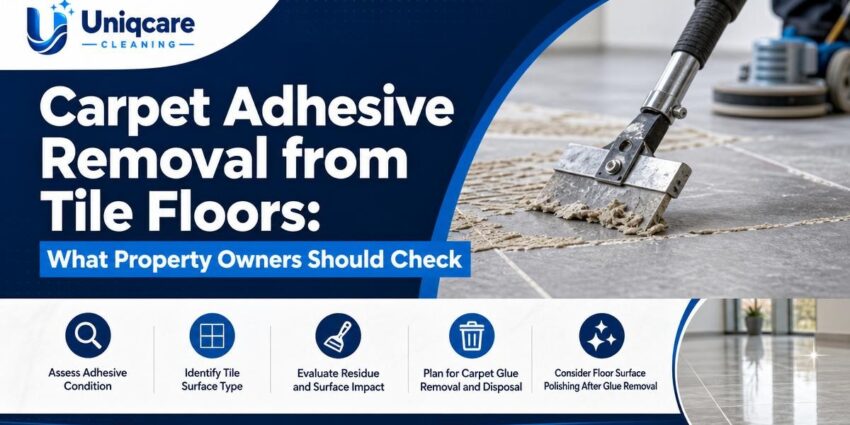
Carpet adhesive removal from tile floors requires more planning than simply pulling up the old carpet. Property owners should check the condition of the glue, identify the tile surface, consider the risk of marks or damage, arrange disposal of the removed carpet and decide whether the floor needs polishing or other follow-up work.
Why carpet removal does not finish the job
When fitted carpet is taken up, the floor underneath may still have adhesive spread across a large area. Some residue may be visible as a thin film, while older glue may be thick, brittle, sticky or firmly bonded to the surface. The condition can vary from one room to another, especially where the carpet has been repaired, replaced in sections or exposed to different levels of foot traffic.
Adhesive can also affect how the floor looks and feels after the carpet has gone. A tile may appear dull where glue remains, show uneven patches after scraping or reveal marks that were hidden for years. This is why a property owner should treat carpet removal, residue assessment and floor finishing as related but separate stages.
First check: what type of adhesive remains?
The visible appearance of the residue gives a useful starting point, but it does not always show how difficult the work will be. Glue may be soft and tacky, dry and hard, patchy, deeply bonded or mixed with backing material from the carpet. Previous attempts to remove it may also have spread the adhesive into a thinner layer across the tile.
| Adhesive condition | What a property owner may notice | Why assessment matters |
|---|---|---|
| Thin residue | A light film, haze or slightly sticky surface | The floor may need careful residue removal before cleaning or finishing |
| Thick adhesive | Raised patches, ridges or visible strips | More material must be lifted without unnecessarily marking the tile |
| Hard or brittle glue | Flaking pieces or solid areas that resist ordinary cleaning | Mechanical removal may require careful control and surface testing |
| Sticky or softened glue | Residue transfers to shoes, tools or cloths | Incorrect handling can spread the adhesive over a larger area |
| Glue mixed with carpet backing | Fibres, foam or underlay remain attached | The material may need to be separated before the floor can be assessed properly |
This check should be carried out before choosing a treatment approach. A method suitable for a dry, thin film may not be appropriate for a thick or softened adhesive. Testing a small, less noticeable section can help establish how the tile responds, but property owners should avoid applying unverified chemicals or aggressive tools across the entire floor.
Identify the tile and floor surface
Not every tile floor responds in the same way to scraping, agitation, cleaning agents or polishing. Ceramic and porcelain tiles, terrazzo, marble and other hard surfaces can have different finishes, levels of porosity and maintenance requirements. Grout lines may also require separate attention because residue can collect along their edges or inside recessed joints.
The original floor specification, renovation records or a small exposed section may help identify the surface. If there is uncertainty, it is better to describe the floor accurately during an assessment rather than assume that every tile can be treated in the same manner. The floor surface is one of the details a professional cleaner will need before planning carpet glue removal.
Points to check on the floor surface
- Whether the tiles are glazed, unglazed, polished or textured.
- Whether adhesive covers only the tile faces or also reaches the grout lines.
- Whether any tiles are cracked, loose, chipped or already scratched.
- Whether the floor has a coating, finish or previous treatment that may react to cleaning.
- Whether the exposed area has colour variation that was hidden by the carpet.
These observations help separate existing floor damage from marks caused during the removal process. Taking photographs before work begins can also give the property owner a useful record of the starting condition.
Check the size and layout of the affected area
The work involved is influenced by more than the amount of visible glue. A small room with many corners, columns, cabinets or built-in fixtures may take more preparation than a larger, open area. Access, ventilation, furniture and the condition of the carpet itself should be considered before the appointment is arranged.
Owners should identify the rooms affected, estimate the approximate floor area and note whether carpet continues under heavy furniture or fixed fittings. It is also useful to decide whether the work will be completed one room at a time or whether the premises can be cleared for a broader removal project.
Information to prepare for an assessment
- Photographs showing the carpet, exposed tile and adhesive residue.
- The approximate size of each affected room.
- The type of property, such as a home, office or commercial space.
- Information about when the carpet was installed, if known.
- Details of earlier removal or cleaning attempts.
- Any concerns about scratches, loose tiles, grout or existing discolouration.
Clear information does not replace an on-site assessment, but it helps a service provider understand the project before discussing the next step. Uniqcare Cleaning provides carpet glue removal and disposal for various flooring surfaces, with optional floor surface polishing described as part of the service.
Do not overlook carpet disposal
Old carpet can become an obstacle once it has been pulled up. It may be bulky, heavy when dirty or damp and difficult to store without blocking corridors, entrances or working areas. If the carpet is removed but left on the property, the owner may still need to arrange transport and disposal separately.
Disposal planning should therefore be discussed at the same time as adhesive removal. Ask whether the service includes collecting the removed carpet, whether the material needs to be cut or bundled, and where it will be placed before collection. The answer may depend on the size of the project and the conditions at the premises.
For offices and commercial spaces, the timing of removal can be especially important. Property managers may need to coordinate access, protect nearby furniture and keep walkways clear. A simple disposal plan reduces the chance that removed carpet becomes a second maintenance problem after the glue work is complete.

Assess the surrounding area before work starts
Adhesive removal can create debris, loosened residue and cleaning material that must be controlled. The area around the work zone should be checked for skirting boards, painted walls, doors, furniture, electrical equipment and floor transitions. Items that cannot be moved should be identified before work begins.
Property owners should also consider how the room will be used during the work. A household may need to keep children or pets away from the area, while an office may need to relocate desks or plan work outside busy hours. These are practical arrangements rather than signs that every project follows the same schedule.
Understand the difference between glue removal and floor restoration
Removing adhesive and restoring the appearance of the floor are connected, but they are not identical services. The first stage focuses on lifting or cleaning the residue. The second may involve additional floor cleaning, polishing or surface work depending on the tile, its condition and the result the owner wants.
A floor may look different after glue has been removed because the carpet protected some sections from light, foot traffic and routine cleaning. There may also be a visible contrast between covered and previously exposed areas. Polishing cannot be assumed to erase every difference, particularly where the tile has pre-existing wear, colour variation or damage.
When to discuss floor surface polishing after glue removal
- The tile looks dull or uneven after the adhesive has been removed.
- The floor has a finish that may benefit from further surface work.
- There are visible marks left by long-term carpet coverage or previous maintenance.
- The owner wants the exposed area to have a more consistent appearance.
- The floor type is listed as suitable for a cleaning or restoration assessment.
Polishing should be discussed as an optional follow-up, not as an automatic result of carpet adhesive removal. A professional can assess whether the surface is suitable and explain what can reasonably be attempted based on its condition.
Questions to ask a carpet glue removal service
Before confirming the work, ask for a clear explanation of what is included. This is particularly important where the property owner expects the floor to be ready for a new carpet, hard-floor use or another renovation stage.
- Will the carpet be removed, or does the service begin after the carpet has already been lifted?
- Is the remaining adhesive assessed according to its condition and the type of floor?
- Are carpet pieces and other removed materials collected for disposal?
- Will the work include grout lines, edges and areas around fixed fittings?
- Is floor cleaning or polishing included, or is it an optional follow-up?
- What existing damage should be documented before work begins?
- What access and preparation are required from the property owner?
The purpose of these questions is not to demand a guaranteed visual result. Adhesive type, tile condition, previous wear and the extent of the affected area can all influence the outcome. A realistic scope helps prevent confusion between residue removal, general floor cleaning and cosmetic restoration.
When professional carpet adhesive removal makes sense
Professional help may be useful when adhesive covers a large room, when the residue is firmly bonded, when the floor surface is valuable or delicate, or when the property needs coordinated carpet removal and disposal. It can also be practical for offices, rental properties and commercial premises where the owner needs a defined work area and a clear handover condition.
Uniqcare Cleaning provides professional deep-cleaning services for residential and commercial clients, including carpet glue removal and disposal. The business serves Kuala Lumpur, Selangor, Putrajaya and Cyberjaya. Property owners can discuss the floor type, adhesive condition, affected area and any interest in floor surface polishing before arranging the service.
A practical owner checklist
Before the appointment, use this checklist to keep the project focused:
- Photograph the carpet, exposed floor and visible adhesive.
- Identify the rooms and approximate floor area involved.
- Record cracked tiles, damaged grout or existing scratches.
- Confirm the likely tile or hard-floor material.
- Clear furniture and protect items near the work area where possible.
- Discuss carpet collection and disposal in advance.
- Ask whether polishing or other floor surface work is optional.
- Agree on what will be assessed after the adhesive has been removed.
Careful preparation gives the property owner a better basis for comparing the before-and-after condition. It also helps the service provider plan around the actual floor rather than relying on assumptions about the adhesive or tile.
Frequently asked questions
What is carpet adhesive removal?
Carpet adhesive removal is the process of removing glue or adhesive residue left on a floor after carpet has been lifted. The work may also include carpet disposal and discussion of follow-up floor surface work.
Can all carpet glue be removed from tile?
The result depends on the adhesive condition, the tile surface, previous damage and how firmly the residue is bonded. An assessment is needed before promising a particular finish.
Should I polish the floor after removing carpet glue?
Polishing may be suitable in some cases, but it is not automatically required. The tile type and its condition should be checked after the residue has been removed.
Does carpet glue removal include disposal of the old carpet?
Uniqcare Cleaning lists carpet glue removal and disposal as a service. Confirm the exact disposal scope for the property, including collection of carpet pieces and any other removed material.
What should I tell the cleaner before requesting an assessment?
Share photographs, the approximate affected area, the likely tile type, the condition of the adhesive and any known previous removal attempts. Mention cracks, loose tiles or existing marks as well.
Where does Uniqcare Cleaning provide carpet glue removal?
Uniqcare Cleaning serves Kuala Lumpur, Selangor, Putrajaya and Cyberjaya. Property owners should confirm availability and the project details when making an enquiry.