
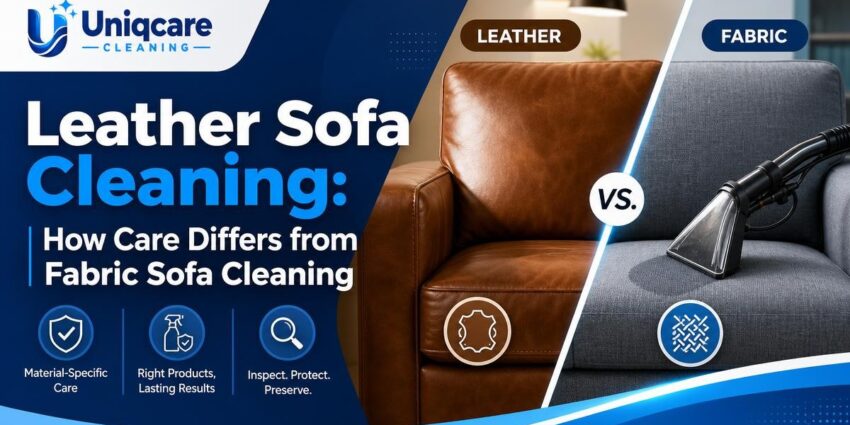
Leather sofa cleaning is not simply a stronger version of fabric sofa cleaning. Leather has a finished surface that can react to excess moisture, unsuitable chemicals and aggressive scrubbing, while fabric upholstery may hold dust, spills and soil deeper between its fibres. Understanding these differences helps you protect the sofa’s appearance and avoid turning a small mark into permanent damage.
Why leather and fabric sofas need different care
A sofa’s material determines how it absorbs liquid, responds to friction and reacts to cleaning products. Fabric upholstery is made from woven, knitted or synthetic fibres that may allow moisture to travel into the padding. Leather is a natural material with a surface finish that can be affected by drying, abrasion, oils and chemicals. Even two sofas that look similar may require different treatment because their finishes, colours, stitching and construction are not identical.
For that reason, a cleaning method should begin with identification and condition assessment rather than with a product. The goal is not to use the most powerful cleaner. It is to use an approach that removes soil while respecting the material and the sofa’s existing condition.
| Consideration | Leather sofa cleaning | Fabric sofa cleaning |
|---|---|---|
| Surface behaviour | Usually has a finished, non-woven surface that can be marked by abrasion or chemical reaction. | Fibres can trap loose soil and absorb spills into the fabric and underlying layers. |
| Main moisture concern | Excess liquid may affect the finish, seams or underlying materials. | Over-wetting may cause slow drying, spreading stains or moisture remaining in the padding. |
| Product concern | Household detergents, solvents and unsuitable conditioners may dull, dry or discolour the surface. | Incorrect detergents, heat or agitation may cause colour change, fibre damage or residue. |
| Assessment focus | Finish, colour, dryness, cracking, peeling and previous treatments. | Fibre type, colour stability, stain type, wear, shrinkage risk and backing construction. |
| Cleaning emphasis | Controlled surface cleaning with attention to finish and condition. | Soil and stain treatment suited to the textile, followed by controlled moisture extraction. |
Leather sofa cleaning: what the material requires
Start by identifying the leather surface
“Leather” describes a broad range of upholstery materials and finishes. A sofa may have a smooth coated surface, a more absorbent finish, or areas made from a different material even when the overall design appears uniform. Some sofas also combine leather with synthetic upholstery on the sides or back. A careful assessment should check the seat, arms, back cushions, piping and hidden areas before cleaning begins.
Condition matters just as much as material. Look for dryness, cracking, peeling, scratches, faded patches, sticky areas and changes in sheen. Cleaning may reveal existing wear rather than cause it, so documenting the condition beforehand is useful. Deep cracks or peeling finishes are material defects that cleaning alone cannot restore.
Use controlled moisture and gentle action
Leather does not need to be saturated to be cleaned. Excessive water can move through seams, affect adhesives or leave the surface difficult to dry evenly. Strong rubbing can also create a shiny patch or remove colour from a worn area. Leather sofa cleaning should therefore rely on controlled application, soft tools and gradual work over manageable sections.
Edges, piping and textured areas deserve extra care because dirt may collect there while the finish is more vulnerable to friction. A cleaning professional may adjust the process after seeing how the surface responds in a discreet test area. This is especially relevant for older sofas, heavily used seating and upholstery that has already been treated with household products.
Be cautious with conditioners and home remedies
Conditioning is not a universal cure for every leather problem. An unsuitable oil, wax or cream may leave a greasy film, alter the sheen or interfere with a later cleaning process. Kitchen oils, alcohol-based products, abrasive powders and general-purpose household cleaners are particularly poor substitutes for a material-appropriate product.
Always follow the sofa manufacturer’s care instructions where they are available. If the instructions are missing or the surface is already damaged, professional assessment is safer than experimenting on a visible cushion. A small hidden test can reduce risk, but it cannot guarantee that every area will react identically.
Fabric sofa cleaning: why textiles need a different approach
Fabric can hold soil below the visible surface
Fabric upholstery often collects loose dust, body oils, food particles and everyday soil within the weave. A sofa can look reasonably clean while dirt remains around seams, under cushions and in frequently used areas. Vacuuming helps remove loose material, but it does not replace a deeper cleaning process when the upholstery has absorbed spills or accumulated embedded soil.
Fabric type influences the appropriate method. Natural and synthetic fibres can respond differently to moisture, agitation, heat and detergents. Colour, pattern, backing and cushion construction also matter. A fabric that is safe to wet in one sofa may not behave the same way in another, even if both are labelled as polyester or appear to have the same texture.
Stain treatment must match the spill and the fibre
There is no single fabric cleaner that is ideal for every mark. A fresh drink spill, greasy food mark, ink-like spot and old discolouration may require different handling. Applying several products one after another can make the situation harder by adding residue or spreading the mark beyond its original edges.
Rubbing is another common mistake. Vigorous scrubbing can roughen fibres, create a lighter-looking patch or push a spill deeper into the cushion. Blotting may be more appropriate for a fresh liquid, but even blotting should be done without forcing moisture through the fabric. If a stain has already been treated at home, tell the cleaning provider which products were used.
Moisture control is central to fabric sofa cleaning
Fabric sofa cleaning commonly involves applying a suitable cleaning solution and removing loosened soil and moisture in a controlled way. The amount of moisture should reflect the fabric, cushion construction and surrounding conditions. Over-wetting may contribute to slow drying, water marks, colour migration or a damp smell, while insufficient rinsing or extraction may leave detergent residue.
Drying conditions also matter. Cushions should not be returned to regular use while they remain noticeably damp. Air movement can help, but the safe drying approach depends on the upholstery and the method used. A professional cleaner should be able to explain any care instructions after the service without promising a fixed drying time for every sofa.

The risks of using the wrong cleaning products
Many sofa problems begin with a well-intentioned product applied without checking the material. A product may remove some visible soil while damaging colour, finish or texture. The risk is greater when the sofa is light-coloured, aged, previously repaired or already showing signs of wear.
- General-purpose detergent: It may leave residue or affect the appearance of leather and textile fibres.
- Bleach or strong disinfectant: These products can alter colour and weaken or mark upholstery.
- Solvents: They may dissolve finishes, spread dyes or create a visibly different patch.
- Abrasive powders: Scrubbing particles can scratch leather finishes or roughen fabric.
- Excessive water: It can move stains, soak padding and make drying more difficult.
- High heat: Heat may affect colour, fibres, coatings or adhesives, depending on the sofa.
- Unverified home remedies: A method that works on one material may damage another.
Product labels also do not tell the whole story. A cleaner may be suitable for one type of leather but unsuitable for another finish, or safe for one textile but risky for a dyed fabric. Material identification and a test area are more reliable than assuming that a product marketed for “upholstery” works universally.
Condition assessment before either type of sofa cleaning
A good assessment looks beyond the most obvious stain. It considers the material, construction and history of the sofa. This helps set a realistic cleaning plan and identifies conditions that need special care or may not be reversible through cleaning alone.
Useful checks before cleaning
- Identify whether each upholstered section is leather, synthetic material or fabric.
- Check care labels and manufacturer instructions if they are available.
- Inspect seams, piping, cushion covers, zips and areas beneath removable cushions.
- Note fading, worn texture, peeling, cracking, dye transfer or previous repairs.
- Identify the location, age and likely type of each stain.
- Ask whether household cleaners, conditioners or stain removers have already been applied.
- Check for loose buttons, damaged stitching or structural issues that should not be disturbed.
Assessment is also important when comparing the expected result with the sofa’s current state. Cleaning can improve the appearance of accumulated soil, but it cannot promise to reverse sun fading, permanent dye loss, severe abrasion, peeling coatings or damage caused by age. Clear expectations protect both the customer and the upholstery.
Which sofa cleaning approach is appropriate?
The right approach depends on the material and condition, not simply on whether the sofa is described as “dirty.” Leather usually calls for careful surface treatment and close attention to the finish. Fabric may need a textile-specific process that addresses embedded soil and controls moisture. Mixed-material sofas require the sections to be treated according to their individual surfaces.
Professional sofa and upholstery cleaning is useful when the material is uncertain, the sofa is valuable, stains are extensive, or previous DIY treatment has produced a visible change. Uniqcare Cleaning provides professional deep-cleaning services for fabric and leather sofas and selected upholstery, with on-site sofa cleaning listed among its services. The company serves residential and commercial clients in Kuala Lumpur, Selangor, Putrajaya and Cyberjaya.
How to prepare for a professional sofa cleaning service
Before arranging a visit, take clear photographs of the sofa and mention its material, approximate age, problem areas and any products already used. If cushions are removable, explain whether the concern affects the covers, inserts or both. It is also helpful to identify areas that need special attention, such as armrests, headrests, dining-chair seats or office furniture.
Move small objects away from the work area and provide access to the sofa. Do not apply another cleaner immediately before the appointment, since additional residue can affect assessment and treatment. Ask what preparation is needed, which parts of the furniture are included and what aftercare instructions will apply to that specific material.
Simple maintenance after cleaning
Regular maintenance reduces the amount of soil that builds up between professional visits. Vacuum fabric sofas using an upholstery attachment, paying attention to seams and removable cushions. For leather, remove loose dust with a soft, clean cloth and avoid rough tools that could mark the finish. Deal with spills promptly using the care instructions for the sofa rather than reaching for a random household product.
- Keep food and drinks away from vulnerable areas where practical.
- Rotate or reposition removable cushions according to the manufacturer’s guidance.
- Limit prolonged direct sunlight where fading is a concern.
- Avoid placing wet items on either leather or fabric upholstery.
- Do not wait until a small mark has been layered with multiple cleaning products.
- Arrange professional advice when odour, staining or material damage persists.
Leather sofa cleaning and fabric sofa cleaning share the same basic goal—removing unwanted soil without harming the furniture—but the route to that goal is different. Leather requires respect for its finish and condition. Fabric requires attention to fibres, dyes, backing and moisture control. When the material is assessed first and unsuitable products are avoided, cleaning becomes a considered care process rather than a trial-and-error exercise.
Frequently asked questions
Can I use fabric sofa cleaner on a leather sofa?
Not automatically. A fabric cleaner may contain ingredients or require moisture levels that are unsuitable for leather. Check the manufacturer’s instructions or obtain a material-specific assessment before using any product.
Is leather sofa cleaning completely dry?
Do not assume that it is. Leather is generally treated with controlled moisture rather than saturation, but the exact process depends on the finish and condition. Ask the cleaning provider what method is appropriate for your sofa.
Why can a fabric sofa look clean but still need deep cleaning?
Fabric fibres can hold dust, oils and soil below the immediately visible surface, particularly around seams and frequently used areas. Surface appearance alone may not show the full level of accumulated soil.
Should I scrub a stain on a fabric sofa?
Hard scrubbing can spread the stain, roughen the fibres or create a lighter-looking patch. Follow the care instructions and use gentle, controlled action. For difficult marks, professional assessment is safer than repeated experimentation.
Can cleaning repair cracked or peeling leather?
No. Cleaning may remove surface soil, but cracking, peeling, severe abrasion and finish failure are condition issues rather than ordinary dirt. These problems may require repair or replacement advice.
What should I tell a sofa cleaning professional?
Provide the material, care-label information, stain history, previous products used and any visible damage. Mention whether the sofa combines leather, synthetic upholstery or fabric sections so each surface can be assessed correctly.
Does Uniqcare Cleaning provide sofa cleaning?
Yes. Sofa and upholstery cleaning is one of Uniqcare Cleaning’s listed services, including deep cleaning for fabric and leather sofas and selected chairs or office furniture. Service coverage includes Kuala Lumpur, Selangor, Putrajaya and Cyberjaya.


