

Furniture moves often reveal carpet problems that were hidden under sofas, cabinets, beds, tables or office equipment. Before attempting carpet stain removal, property owners should record what they can see: the stain type, approximate age, exact location, size, surrounding carpet condition and any marks caused by furniture legs. Clear notes and photographs give a cleaning professional useful background and help owners distinguish between removable soiling, long-term discolouration and physical carpet damage.
Why furniture moves can reveal different carpet conditions
Carpet does not always age evenly. Areas exposed to foot traffic, sunlight, spills and cleaning products may look different from sections that have been covered for months or years. When furniture is moved, the newly exposed area can appear brighter, darker, cleaner or more compressed than the surrounding carpet. A mark that looks like a stain may instead be a pressure impression, a difference in pile direction, colour variation or damage to the fibres.
This distinction matters because cleaning addresses soil and some staining, while crushed pile, fading, fibre damage or backing problems may not respond in the same way. Recording the condition before cleaning gives everyone a more accurate starting point. It also helps when a tenant, landlord, facilities manager or property owner needs to document the condition of a room before and after furniture relocation.
What to record before carpet stain removal
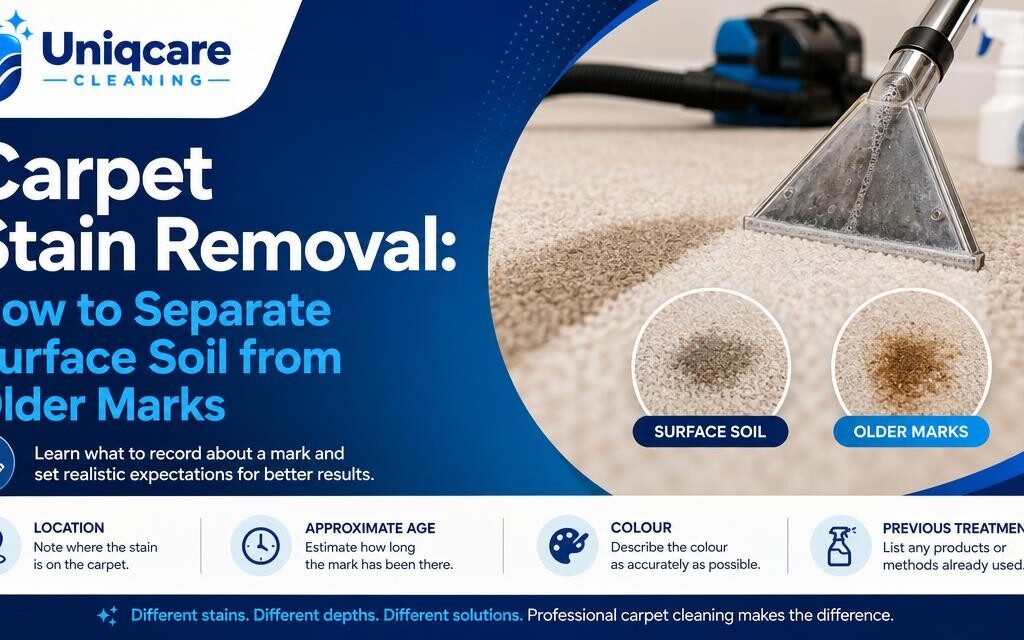
Take a slow walk around the exposed carpet before applying a product or rubbing the area. Record observations in plain language rather than trying to diagnose the stain with certainty. For example, “dark brown mark beside the former sofa position” is more useful than simply writing “dirty carpet.” If the carpet is in a rented property or commercial space, include the room name and date in the record.
| Information to record | What to note | Why it helps |
|---|---|---|
| Stain appearance | Colour, shape, edges, wet or dry appearance and whether it feels sticky or stiff | Provides an initial description without assuming the cause |
| Possible source | Food, drink, oil, mud, ink, rust, pet accident or unknown source | Different substances may need different cleaning considerations |
| Age | When it was first noticed and whether it may have existed before furniture was moved | Older marks may have bonded to fibres or changed colour |
| Location | Room, distance from walls, nearby furniture position and relation to a doorway | Makes the area easy to identify during inspection |
| Size | Approximate length and width, plus whether there are separate spots | Shows the overall scope of the affected area |
| Carpet condition | Fibre type if known, pile direction, crushing, fraying, fading or loose edges | Helps separate staining from physical or colour-related issues |
| Previous treatment | Products, tools, home remedies or earlier cleaning attempts | Residue from earlier treatment can affect the next cleaning process |
Record the stain type without overpromising a diagnosis
A visual description is a useful first step, but appearance alone may not reveal what caused a mark. A pale ring could be residue, water-related marking or a change in carpet colour. A dark patch could be soil, oil, moisture-related discolouration or a shadow from the surrounding pile. If the source is unknown, write “unknown” rather than guessing.
Note whether the mark is dry, damp, tacky, crusted or associated with an odour. Do not deliberately wet the carpet to test it. Unplanned moisture can spread a substance, drive it further into the pile or create a larger area that is harder to assess. A professional carpet cleaning provider can use the recorded information alongside an inspection of the material and its condition.
Estimate how old the mark is
Stain age is often uncertain after furniture has been moved. The mark may have been created recently, or it may have been hidden beneath the furniture for a long period. Record the last time the area was visible, if known, and whether anyone remembers a spill or accident. For an office or commercial property, check whether the furniture was installed, relocated or cleaned on a particular date.
Age does not by itself determine whether carpet stain removal will succeed. A recent mark may still require careful treatment, while an older mark may have altered the colour of the fibre or backing. The most helpful record combines the approximate timeline with the stain’s present appearance and any previous attempts to clean it.
Mark the exact location
Location notes should be specific enough that another person can find the mark without moving every item in the room. Use a simple reference such as “two metres from the north wall, beside the left rear leg of the desk” or “near the doorway between the reception area and corridor.” If a floor plan is available, mark the affected spot on it.
Location can also provide useful context. Marks beside a doorway may relate to heavy traffic, while rectangular differences beneath furniture may reflect coverage and fading rather than a spill. Several spots arranged along furniture legs may indicate repeated pressure or contact with a material underneath the item. These are observations, not conclusions, so record them separately from any suspected cause.
Photographs that make the record more useful
Photographs should show both the overall room and the close-up detail. Take one image that shows where the mark sits in relation to walls, doors and furniture. Follow it with a closer image showing the stain’s edges and texture. Include a ruler or another familiar object for scale when appropriate, while avoiding anything that could transfer colour, moisture or dirt to the carpet.
- Photograph the area before applying any cleaning product.
- Use consistent lighting where possible, since shadows can make carpet colour look uneven.
- Take images from directly above as well as from a normal standing position.
- Capture nearby carpet that appears unaffected for comparison.
- Keep the original files and record the date and room.
- Do not edit colour or brightness if the images may be used for a property condition record.
Photographs cannot confirm the exact cause of a mark, but they preserve a useful visual record. This is particularly helpful when furniture has already been removed from the property or when a cleaning provider is assessing the work before an appointment.
Separate stains from furniture pressure marks
Furniture legs and heavy items can compress carpet pile. Once the item is moved, the area may show square, round or linear impressions. The colour may look different because the fibres are lying in another direction, not because a liquid or soil has been deposited. You may also see a clean outline around a previously covered area, especially when the surrounding carpet has experienced more traffic.
Record pressure marks as part of the carpet condition rather than automatically listing them as stains. Note the shape, size, depth and position of each impression. Look for associated issues such as torn fibres, loose seams, damaged edges or a backing that appears distorted. Do not scrape, brush aggressively or use high heat to force the pile upright. A cleaning professional can advise whether the appearance is primarily related to soiling, pile compression or another condition.
Check the carpet’s wider condition
Carpet stain removal should be planned with the whole area in mind, not just the most noticeable spot. Inspect the carpet around the exposed section for general soiling, traffic lanes, fading, patchiness, loose threads, frayed edges and signs of previous cleaning. Also check whether the carpet is wall-to-wall, a rug or a removable section, since the construction and handling requirements may differ.
If the carpet feels damp, has persistent odour or shows signs of water exposure, record that separately and mention it when requesting help. Affected carpet may need a different assessment from an ordinary dry stain. Uniqcare Cleaning lists carpet cleaning for homes, offices, wall-to-wall carpets and area rugs, as well as flooded carpet cleaning for water-affected situations. The appropriate service depends on the carpet’s condition and the circumstances involved.
Details that matter in homes and rentals
Homeowners and tenants should record which furniture was moved, who moved it and whether protective pads or mats were underneath. If the area is part of a handover or tenancy inspection, include the inspection date and keep the photographs with other property records. Avoid stating that a tenant or previous occupant caused the damage unless there is reliable evidence.
A neutral description is stronger than an accusation. Write “dark mark found after wardrobe relocation” rather than “wardrobe caused permanent damage.” This approach preserves the facts while leaving room for a professional inspection to determine whether the issue is staining, compression, fading or a combination of conditions.
Details that matter in offices and commercial premises
For offices, retail spaces and other commercial premises, identify the room, department or work zone. Record whether the carpet is used in a walkway, under desks, near an entrance or in a meeting area. Note whether several marks follow the same furniture layout or whether the affected area is isolated.
It is also useful to record access considerations, working hours and whether furniture will remain moved. These practical details help a professional carpet cleaning provider understand the site before discussing the work. They do not replace a site assessment, especially where large areas, fixed furniture or different carpet materials are involved.
What to avoid before professional carpet cleaning
Well-intended home treatment can make an unknown stain more difficult to assess. Strong chemicals, excessive scrubbing and repeated wetting may spread the mark, alter the carpet colour or leave residue. Some products can also affect the appearance of the surrounding fibres, making a small spot look more obvious after drying.
- Do not mix cleaning chemicals.
- Do not use bleach or an untested product on a visible area.
- Do not scrub aggressively, especially on looped or delicate carpet.
- Do not saturate the carpet without knowing how it will be dried.
- Do not cover a damp area with furniture or plastic.
- Do not assume that a stain remover suitable for one carpet is suitable for another.
If you have already tried a product, record its name if known, how much was used and when it was applied. Tell the cleaning provider about it before work begins. This information can be as important as the original stain description.
How a professional carpet cleaning assessment uses your notes
Your record gives a professional carpet cleaning team a clearer starting point, but it does not guarantee a particular result. The team may consider the fibre and carpet construction, the condition of the backing, the stain substance, how long it has been present and whether previous products have left residue. Hot water extraction or steam cleaning may be suitable for some carpets, while other situations call for a more cautious approach.
Good carpet stain removal is therefore not simply a matter of applying a stronger chemical. It involves identifying the likely type of soiling, choosing a method appropriate to the carpet and recognising when a mark may actually be fading, fibre damage or furniture compression. Results can vary according to the material, condition and stain type, so property owners should ask for an assessment rather than assume that every mark can be completely removed.
A practical recording checklist
Before contacting a professional carpet cleaning provider, gather the following information. A short, accurate record is usually more useful than a long explanation based on guesses.
- Write the date and name of the room.
- Describe each mark’s colour, shape, texture and approximate size.
- State whether the mark is dry, damp, sticky, crusted or associated with an odour.
- Record when the furniture was moved and when the mark was first noticed.
- Mark the location in relation to walls, doors and former furniture positions.
- Photograph the full setting, close-up detail and nearby unaffected carpet.
- Note carpet type or construction if that information is available.
- Record fading, crushing, fraying, loose edges, dampness and other visible conditions.
- List previous cleaning products, tools or services used on the area.
- Keep any tenancy, handover or maintenance notes together with the photographs.
When to request carpet stain removal
Arrange an assessment when the mark remains visible after normal dry vacuuming, when its source is unknown, or when the carpet’s condition makes DIY treatment uncertain. Professional help is also sensible when a large area is affected, several stains have appeared, a previous cleaning attempt has left residue, or furniture pressure marks are being confused with staining.
Uniqcare Cleaning provides professional deep-cleaning services for residential and commercial clients, including carpet cleaning for homes, offices, wall-to-wall carpets and area rugs. The company serves Kuala Lumpur, Selangor, Putrajaya and Cyberjaya. Share the recorded details before the appointment so the discussion can focus on the actual carpet, the visible condition and the result you are seeking.
Frequently asked questions
Why do stains become visible after furniture is moved?
Furniture can hide spills, soil, fading and pressure marks for a long time. Moving the item exposes the covered area and creates a visual contrast with the surrounding carpet.
Can photographs identify the cause of a carpet stain?
Photographs can document appearance, size and location, but they usually cannot confirm the exact substance or cause. A professional assessment may still be needed.
Should I clean the stain before recording it?
No. Photograph and describe the area first. If you have already treated it, record the product, method and timing so the cleaning provider knows what has been attempted.
Are furniture impressions the same as carpet stains?
No. Furniture impressions are often caused by compressed pile or a change in fibre direction. They should be recorded separately from marks caused by spills or soil.
What if I do not know how old the stain is?
Write that the age is unknown and record when the furniture was moved and when the mark was first noticed. Avoid guessing unless someone has reliable information about the event.
Can professional carpet cleaning remove every mark?
No result should be assumed in advance. Outcomes depend on the carpet material, condition, stain type, age and previous treatment. An assessment can provide a more realistic expectation.
What should I tell a carpet cleaning provider before an appointment?
Share the stain description, photographs, approximate size, location, age if known, carpet type, previous treatments and any dampness, odour or physical damage.