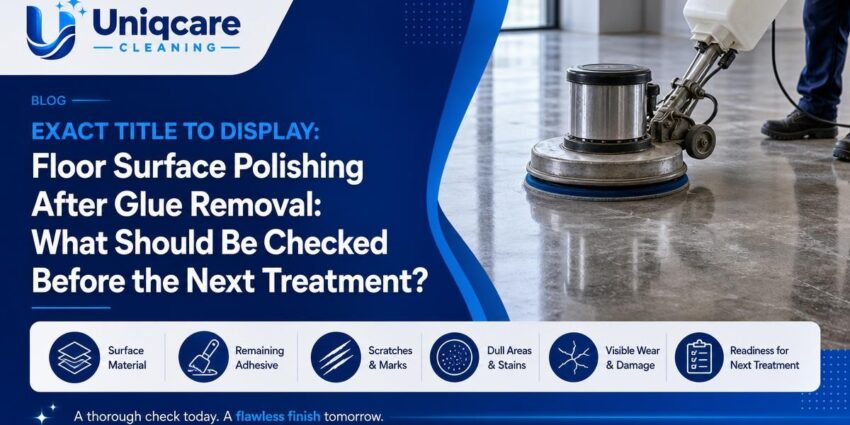
Floor surface polishing after glue removal should begin with an inspection, not with a polishing machine. Once old carpet or adhesive has been removed, the exposed surface may show residue, scratches, dull areas, colour variation or wear that was hidden underneath. Checking these conditions first helps determine whether polishing is suitable, what preparation is needed and whether the expected finish is realistic.
Why the floor needs to be checked before polishing
Removing carpet glue can change the appearance of a floor quite dramatically. Areas protected by carpet may look different from exposed edges, while adhesive may leave patches that feel sticky, rough or uneven. Scraping can also create marks, especially when the adhesive has bonded strongly or when the underlying surface is already worn.
Polishing is intended to improve the appearance of a suitable surface. It is not a universal way to hide every defect left after floor glue removal. If residue remains, polishing may spread it across the surface. If the flooring is damaged or unsuitable for the proposed treatment, an aggressive process could make the condition worse. A proper assessment therefore comes before choosing any polishing method, pad, chemical or finishing treatment.
What to identify about the floor surface
Determine the flooring material
The first question is what material has been exposed. Tile, terrazzo, marble, hardwood, vinyl, laminate and epoxy flooring do not respond in the same way to moisture, abrasion or polishing products. The floor cleaning service should identify the material as accurately as possible before recommending the next step.
Some floors are designed to receive polishing or a protective finish, while others may only need careful cleaning. A treatment that is appropriate for a hard mineral surface may be unsuitable for a resilient floor covering, a coated surface or a floor with a decorative printed layer. When the material is uncertain, a small inconspicuous test area can help guide the assessment, although testing should be performed carefully.
Check whether the surface has a coating
A floor may have an existing coating, sealant or finish. Glue removal may have affected this layer unevenly, leaving areas that are glossy beside areas that look flat or cloudy. In that situation, the visible issue may not be the floor material itself. It may be a worn, partly removed or contaminated finish.
The next treatment could involve cleaning, local preparation, re-coating or a different restoration approach rather than simple polishing. This distinction matters because polishing a damaged coating may produce an inconsistent appearance.
Inspect for remaining adhesive
Remaining adhesive is one of the most important points to check after carpet glue removal. Residue can appear as a visible film, dark patch, yellowed mark, sticky spot or raised area. Some residue is easy to see, while a thin layer may only be detected by touch, reflected light or a change in floor texture.
Before polishing, inspect the entire exposed area rather than only the most obvious spots. Pay attention to edges, corners, joints, transitions and places where carpet was firmly bonded. Loose particles and scraping debris should also be removed so they do not become trapped beneath equipment or create additional marks.
| Condition found after glue removal | Why it matters before polishing | What may need to happen first |
|---|---|---|
| Sticky or soft adhesive residue | It can spread, collect dust or interfere with a consistent finish. | Further adhesive removal and suitable surface cleaning. |
| Hard raised residue | Equipment may catch on high spots or leave uneven results. | Careful mechanical or manual removal. |
| Thin adhesive film | It may be difficult to see but can affect the final appearance. | Close inspection and controlled cleaning or testing. |
| Residue in joints or edges | These areas can remain visibly dirty after the main floor is treated. | Detailed edge and joint cleaning. |
| No obvious residue | The floor may still have scratches, wear or colour variation. | Material and condition assessment before polishing. |
Do not assume that a floor is ready simply because the carpet has been lifted. Adhesive removal and polishing are separate stages, and the quality of the second stage depends heavily on the first.
Look for scratches and scraping marks
Scratches may come from previous furniture movement, foot traffic, carpet installation or the glue removal process. Fine marks can become more visible after the floor is cleaned because dirt no longer disguises them. Deeper scratches may catch a fingernail, show a different colour or expose an underlying layer.
The direction and depth of the marks are useful clues. Light surface marks may respond to an appropriate cleaning or polishing process, but deeper damage may require a more specific restoration method. On floors with a surface layer, repeated aggressive polishing could remove more of that layer. The proposed treatment should therefore match the actual condition rather than the desired appearance alone.
Separate dirt marks from physical damage
A dark line is not automatically a scratch. It may be adhesive, embedded dirt, a rubber transfer mark or a change in the old floor finish. Conversely, a mark that remains after cleaning may indicate physical wear. Distinguishing between these conditions helps avoid using abrasion where cleaning would be enough, or expecting cleaning to correct damage that needs restoration.
Assess dull areas and changes in sheen
Dull patches are common after carpet or adhesive removal because the floor has been exposed unevenly over time. The centre of a room may have been protected while the perimeter remained exposed to sunlight, moisture, movement and regular cleaning. Once the carpet is gone, these differences can appear as bands, patches or outlines.
Compare the exposed area under different lighting conditions. Natural light and overhead lighting may reveal different levels of sheen. Look across the floor from a low angle, not only straight down. This can show uneven reflection, cloudy areas and shallow marks that are easy to miss during a quick walk-through.
Uneven dullness does not always mean the entire floor needs a stronger treatment. A professional assessment may determine whether the surface needs more cleaning, controlled polishing, finish adjustment or a broader treatment to create a more consistent appearance. The result may also be influenced by the condition of adjoining areas that were not covered by carpet.
Check visible wear and surface condition
Wear usually appears in places where people walk repeatedly, where furniture has moved or where moisture and dirt have affected the floor. Look for worn paths, faded sections, chipped edges, small pits, open joints or areas that feel rough. These details are especially important when preparing a commercial space, office or frequently used room.
Visible wear can affect both the appearance and the practical suitability of polishing. A polished surface may make existing contrast easier to notice if worn and unworn sections reflect light differently. For this reason, the inspection should cover the whole treatment area and not only the former carpet footprint.
Check the condition of edges and transitions
Edges often require more attention than the open centre of the floor. Adhesive can remain near skirting boards, thresholds, floor trims and doorways. These areas may also have a different finish or may be more vulnerable to scraping. Check transitions between flooring materials as well, since the treatment appropriate for one surface may not be appropriate for the next.
Consider moisture and cleaning residues
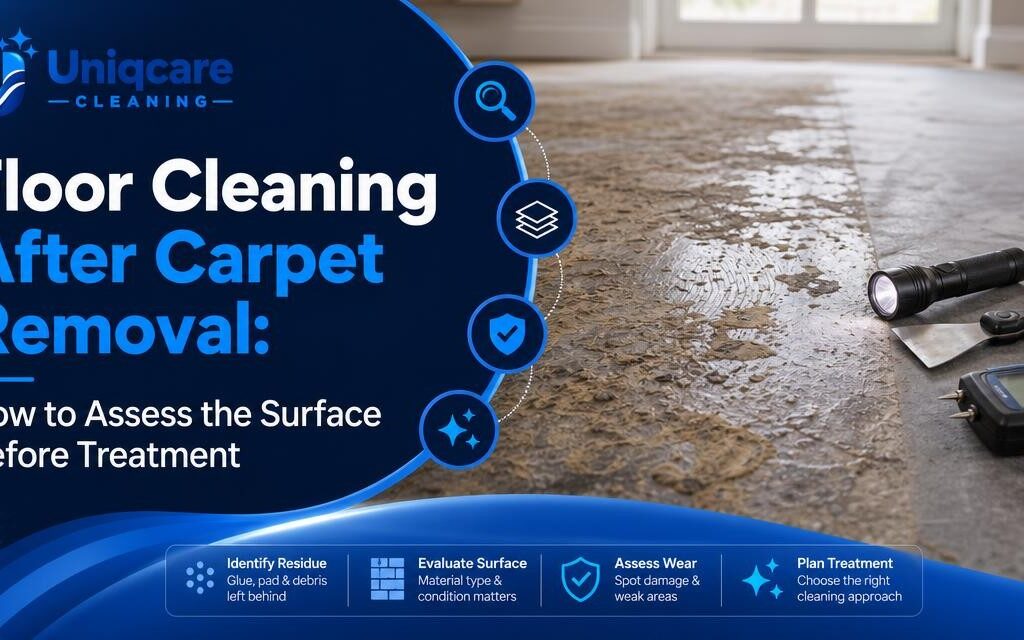
After glue removal, the floor should be checked for moisture, chemical residue and loose debris before polishing. Moisture may remain in joints, porous surfaces or areas that received wet cleaning. Cleaning products that have not been properly removed can also affect how a finish behaves.
The required preparation depends on the floor material and the work already completed. A suitable process may include controlled cleaning, rinsing where appropriate, drying and a final inspection. Exact drying conditions should not be assumed because they vary with the surface, room conditions and cleaning method.
Polishing over a damp, dirty or chemically contaminated surface can lead to an uneven result. It may also make later correction more difficult. The safest approach is to confirm that the surface is clean, stable and ready for the proposed treatment.
Questions to discuss before approving the next treatment
When requesting floor surface polishing after glue removal, ask for a clear explanation of what the inspection found and what the proposed process is intended to improve. A useful discussion should cover the floor material, the condition of the adhesive residue and the difference between cleaning, polishing and restoration.
- What type of flooring is exposed?
- Is any adhesive still present, including along edges and joints?
- Are the visible marks dirt, residue, scratches or wear?
- Does the floor have an existing coating or finish?
- Will the proposed process treat the whole area or only selected patches?
- What appearance can reasonably be expected from the current condition?
- Will a small test area be considered before wider treatment?
These questions are particularly useful when several contractors are being considered. They encourage a condition-based recommendation rather than a promise based only on the name of the service.
How the inspection affects the treatment plan
Once the surface has been assessed, the next step may be straightforward polishing, additional floor glue removal, detailed cleaning or a more careful restoration plan. The correct sequence depends on the material and defects present. In some cases, the floor may need preparation before any polishing is attempted. In others, polishing may not be the best way to address deeper damage or a failing coating.
| Inspection result | Likely planning consideration |
|---|---|
| Clean, stable surface with light dullness | A suitable polishing process may be discussed after material testing. |
| Small areas of adhesive residue | Complete local residue removal before treating the surrounding floor. |
| Widespread residue or uneven texture | More preparation may be needed before a consistent finish is possible. |
| Fine scratches and surface marks | Determine whether cleaning or controlled polishing can address them. |
| Deep scratches, chips or worn coating | Discuss whether polishing alone is appropriate for the desired result. |
| Different flooring materials in one area | Plan separate methods and protect adjacent surfaces. |
This staged approach helps prevent unnecessary abrasion and makes the scope of work easier to understand. It also gives the property owner a more realistic basis for deciding whether the proposed treatment is suitable.
When professional floor cleaning support is useful
Professional support can be helpful when adhesive covers a large area, the floor material is uncertain or the surface shows several different problems at once. It is also useful when a room must be prepared for a new carpet, renovation, tenancy handover or return to regular use.
Uniqcare Cleaning provides floor cleaning services for flooring types listed in its service information, including hardwood, tile, terrazzo, vinyl, laminate, epoxy and marble. The company also provides carpet glue removal and disposal, with floor surface polishing described as an optional part of that service. The appropriate work should still be confirmed after assessing the actual floor condition.
Uniqcare Cleaning serves residential and commercial clients in Kuala Lumpur, Selangor, Putrajaya and Cyberjaya. When requesting an assessment, provide details about the old carpet, the adhesive, the flooring material and any visible damage. Photos may help with an initial discussion, but an on-site assessment may be needed to judge texture, residue and wear accurately.
A practical pre-polishing checklist
Before approving the next treatment, use this checklist to confirm that the main issues have been considered:
- Identify the floor material and any existing coating.
- Inspect the full area, including edges, corners, joints and transitions.
- Check for sticky, hard or thin adhesive residue.
- Remove loose debris left by scraping or carpet removal.
- Look for scratches, gouges, chips, worn paths and colour variation.
- Compare dull and glossy areas under different lighting.
- Confirm that cleaning chemicals and excess moisture have been addressed.
- Ask whether polishing is suitable for the current surface.
- Discuss whether a test area is appropriate.
- Clarify the expected appearance without assuming that every mark can be removed.
Good preparation does not guarantee that an old floor will look new, but it improves decision-making and reduces the risk of choosing an unsuitable treatment. The condition of the original surface, the type of adhesive and the history of wear will all influence the final appearance.
Final thoughts
Floor surface polishing after glue removal should be treated as a condition-based process. Before polishing begins, check the material, remaining adhesive, scratches, dull patches, visible wear, coatings, moisture and edge details. These findings determine whether polishing is appropriate and what preparation should come first.
A careful inspection also makes the conversation with a cleaning professional more practical. Instead of asking only whether the floor can be polished, you can discuss what is present on the surface, what the treatment is designed to improve and what limitations may remain. For carpet glue removal, floor cleaning and possible polishing support, Uniqcare Cleaning can be contacted to discuss the flooring and the required work.
Frequently asked questions
Can floor polishing begin immediately after carpet glue removal?
Not always. The surface should first be checked for remaining adhesive, loose debris, moisture, scratches, coatings and visible wear. Further cleaning or preparation may be required before polishing.
Why is remaining adhesive a problem for polishing?
Adhesive residue can remain sticky, create raised areas or form a thin film. Polishing over it may spread the residue or produce an uneven finish, so it should be assessed and addressed first.
Can polishing remove all scratches left after floor glue removal?
That depends on the depth of the scratches and the flooring material. Light surface marks may respond to a suitable process, while deeper damage may require a different restoration approach.
How can I tell whether a dull patch needs cleaning or polishing?
A dull patch may be caused by residue, dirt, a worn coating or physical wear. A close inspection and suitable test area can help distinguish the cause before selecting a treatment.
Does every type of floor respond to the same polishing method?
No. Tile, terrazzo, marble, hardwood, vinyl, laminate and epoxy have different surface characteristics. The method and products should be selected according to the flooring material and its condition.
Should the whole floor be polished or only the former carpeted area?
That depends on the difference between the covered and exposed sections, the condition of adjoining areas and the desired appearance. Treating only one patch may leave visible variation, so the full area should be assessed.
What information should I provide when requesting floor glue removal and polishing?
Share the flooring type, approximate affected area, age or condition of the carpet, adhesive details if known, visible scratches or dull patches and whether the space is residential or commercial. Photos can help with an initial discussion.