
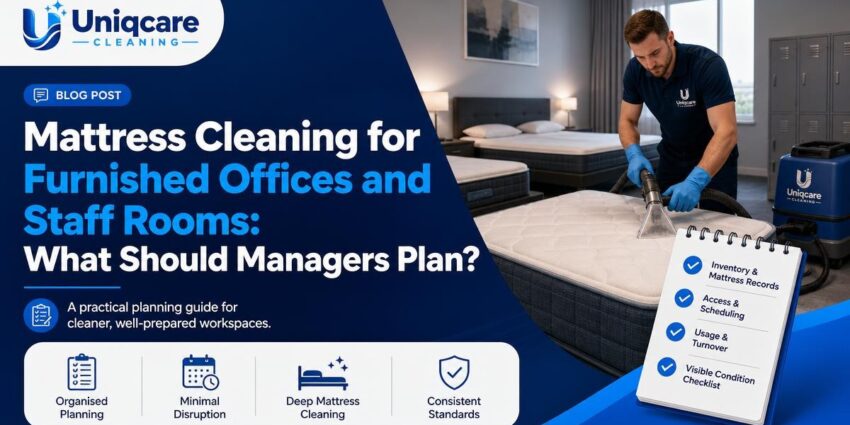
Arranging mattress cleaning services for a furnished office, staff room or accommodation area involves more than booking a single mattress. Managers need a clear record of each item, a practical access plan, realistic expectations about visible condition and enough time to coordinate rooms around their normal use. A structured approach helps reduce disruption and gives the cleaning team useful information before work begins.
Why multi-room mattress cleaning needs a plan
A home usually has only a small number of mattresses in familiar rooms. A commercial premises may have mattresses distributed across staff rooms, rest areas, furnished accommodation, temporary sleeping quarters or separate sections of a building. Each room can have a different user, access restriction, condition and schedule.
Without a plan, managers may overlook a mattress, send cleaners to an occupied room or discover that some items cannot be moved or treated on the arranged date. Planning also makes it easier to distinguish routine cleaning from items that need closer inspection because of visible marks, unusual odours, moisture exposure or material concerns.
| Planning area | What to record | Why it helps |
|---|---|---|
| Mattress register | Room, bed position, size and identification number | Prevents items being missed or confused |
| Usage | Regular, occasional, shared or currently unused | Supports sensible scheduling and prioritisation |
| Condition | Stains, odour, dampness, damage or general wear | Gives the service provider useful background before arrival |
| Access | Room availability, keys, lifts, corridors and security procedures | Reduces delays on the service day |
| After-cleaning plan | Who checks the rooms and when beds can be used again | Creates a clear handover process |
Start with a mattress register
A simple register is one of the most useful tools for a multi-room project. It does not need to be complicated. A spreadsheet or printed checklist can identify every mattress, its location and its current status. If rooms change occupants regularly, the register can be updated after each cleaning visit.
Details worth including
- Building, floor and room number
- Bed or mattress position within the room
- Mattress size and type, if known
- An internal asset or room reference
- Current user or department, where relevant
- Last known cleaning date
- Visible condition and any areas of concern
- Access notes, such as restricted rooms or key requirements
- Planned status, such as scheduled, completed or requiring follow-up
Photographs can also help managers create a before-and-after record, particularly when visible marks or general discolouration are part of the reason for the work. Images should be taken consistently and stored according to the organisation’s privacy and record-keeping procedures. The purpose is to document the item, not to make assumptions about the cause of a mark.
Separate routine cleaning from problem items
Not every mattress needs the same level of attention. Some may be included as part of a planned maintenance cycle, while others may be prioritised because they show visible staining, an odour, signs of dampness or heavy use. Listing these differences in advance helps the provider understand the scope of the visit.
Managers should describe the condition accurately rather than promising a particular result. Stain removal and odour reduction can depend on the material, age, substance involved and previous cleaning attempts. Deep mattress cleaning can improve the condition of many items, but no cleaning service should be expected to restore every mattress to a new appearance.
A practical condition scale
- Routine: No specific visible issue, but the mattress is due for planned cleaning.
- Visible marks: Stains or discolouration are present and should be pointed out before service.
- Odour concern: An unusual smell has been noticed and should be described without assuming its source.
- Moisture-related concern: The mattress has been exposed to damp conditions or a spill and needs assessment.
- Damage or replacement review: The cover, seams, foam or structure appears damaged and cleaning may not be the only consideration.
This type of classification is useful for budgeting and prioritisation, but it is not a diagnosis of the mattress. If an item is badly damaged, persistently damp or unsuitable for continued use, the manager may need to review replacement or specialist advice separately.
Plan access before booking mattress cleaning services
Access is one of the most common practical issues in multi-room cleaning. A mattress may be inside a locked staff room, a shared accommodation area, a security-controlled office or a room used for meetings and rest periods. The cleaning team needs to know how to reach the work area and whether the mattress can be handled safely within the available space.
Questions for the facilities or office team
- Which rooms will be available on the proposed service date?
- Who will provide keys, access cards or an escort?
- Are there building security, loading or visitor procedures to follow?
- Are lifts, stairways and corridors suitable for moving equipment?
- Will furniture need to be moved before the team arrives?
- Are there narrow doorways, fixed beds or other access restrictions?
- Can the team work without blocking emergency routes or busy passages?
- Who should be contacted if a room cannot be opened?
It is also helpful to identify a manager or facilities contact who can make decisions during the visit. If the condition differs from the original description, that person can confirm whether an item should be cleaned, postponed or referred for a separate review.
Coordinate around room usage
Staff rooms and furnished accommodation are often used throughout the day. A room may be empty in the morning but occupied later, or one mattress may be used while another is waiting for a new occupant. Managers should therefore schedule cleaning around actual usage rather than relying only on a general office timetable.
Create a room-by-room schedule that shows which rooms are being treated and which remain available. If several mattresses are in one area, consider whether the room can be temporarily taken out of use while work is carried out. The cleaning provider can advise on practical scheduling details after reviewing the number of items, room layout and service requirements, but the manager remains responsible for communicating room availability.
Useful scheduling principles
- Prioritise rooms with the greatest operational need or most visible condition concerns.
- Group nearby rooms where access and building rules allow it.
- Avoid booking during shift changes, check-in periods or important meetings.
- Tell occupants in advance which rooms or beds will be unavailable.
- Allow time for the mattresses and rooms to be checked before normal use resumes.
- Keep a contingency plan for rooms that cannot be accessed on the day.
Do not advertise or assume a specific drying time unless it has been confirmed for the particular mattress, method, room conditions and service arrangement. Instead, ask the provider what post-cleaning handling instructions apply to the materials being treated.
Prepare the room and surrounding items
Preparation can make the work more efficient and reduce the chance of personal belongings being left in the cleaning area. Staff or room occupants should remove sheets, blankets, pillows and personal items before the scheduled visit unless the provider gives different instructions.
Managers should also decide who is responsible for moving bedside items, detachable bed components or nearby furniture. Some furniture may be heavy, fixed or unsuitable for moving without assistance. A clear division of responsibility prevents the cleaning team from being expected to handle items that were not included in the booking.
Before the cleaning team arrives
- Strip the bed and place linen in the organisation’s normal laundry area.
- Remove bags, clothing, documents and personal belongings from the room.
- Clear a safe working route from the entrance to the mattress.
- Mark mattresses that should not be treated until their condition is reviewed.
- Secure confidential documents and valuable items.
- Inform occupants, security staff and reception about the scheduled work.
- Share any known material, access or condition information with the provider.
For furnished offices, this preparation may include coordinating with housekeeping, human resources, facilities staff or an accommodation supervisor. Assigning one person to manage communication can prevent conflicting instructions.
Ask what the service includes
“Mattress cleaning” can mean different things to different customers. Before confirming mattress cleaning services, managers should ask how the provider assesses the item, what cleaning method is suitable, how visible stains are handled and whether any limitations apply to specific fabrics, covers or mattress constructions.
Uniqcare Cleaning lists professional mattress cleaning among its deep-cleaning services for residential and commercial clients. When requesting a quotation or appointment, a manager can provide the number of mattresses, room locations, access details, photographs where appropriate and a summary of the condition. This gives the company a clearer basis for discussing the requested work.
Questions to ask the provider
- Can the service cover multiple rooms in one commercial booking?
- What information is needed to assess the mattresses before the visit?
- Are there materials or conditions that require special handling?
- How should heavily marked, damp or damaged mattresses be identified?
- What should staff do with linen and nearby furniture?
- What instructions apply after cleaning?
- Will the work be recorded by room or mattress reference?
These questions are especially useful when a premises has a mixture of regular-use beds, spare mattresses and furnished rooms with different layouts. They also help managers avoid treating a large booking as though every mattress has the same requirements.
Build a repeatable maintenance record
A one-time cleaning visit can solve an immediate housekeeping need, but a repeatable record helps managers plan future work. After the service, update the register with the date, room, item reference, observed condition and any instructions provided. If an item was not treated, record the reason so it does not disappear from the next review.
The record can support broader facilities planning alongside carpet, sofa, curtain and floor cleaning. For example, a furnished accommodation area may be reviewed room by room, while a staff rest area may be scheduled according to usage and visible condition. Keeping these records separate from medical or personal assumptions helps the organisation maintain a clear, factual approach.
| After-service record | Example entry |
|---|---|
| Date completed | Date of the cleaning visit |
| Location | Building, floor and room reference |
| Item identification | Bed or asset number |
| Scope | Mattress cleaned, assessed or postponed |
| Condition notes | Visible marks or material observations recorded factually |
| Follow-up | Recheck, replacement review or no further action |
Choosing a commercial mattress cleaning provider
For a multi-room booking, managers should look for a provider that can discuss the practical scope rather than accepting an incomplete room list. Useful signs include willingness to review access requirements, clear communication about limitations and an approach that distinguishes routine cleaning from items needing further assessment.
Uniqcare Cleaning provides professional deep-cleaning services for homes, offices and commercial spaces, including mattress cleaning. The company serves Kuala Lumpur, Selangor, Putrajaya and Cyberjaya. Managers can contact the business to discuss a commercial requirement, room count and access arrangements. The listed telephone number is 019-309 7102, with operating hours stated as Monday to Saturday, 8:30 to 17:00.
When contacting a provider, prepare the information in one message where possible: the number of mattresses, the premises type, the relevant area, access restrictions, preferred dates and any visible condition concerns. This can make the initial discussion more efficient and help the provider determine what further details are needed.
A manager’s final planning checklist
- Count every mattress across the relevant rooms.
- Create a register with room and item references.
- Record visible condition without assuming the cause.
- Separate routine items from priority or problem items.
- Confirm access, keys, escorts, lifts and working routes.
- Coordinate the schedule with occupants and shift patterns.
- Remove linen and personal belongings before the visit.
- Ask the provider about material limitations and after-cleaning instructions.
- Assign one person to manage decisions on the service day.
- Update the cleaning record after each mattress is completed or postponed.
Good planning turns mattress cleaning from an isolated housekeeping task into a manageable facilities process. A clear register, realistic condition notes and coordinated access allow managers to arrange deep mattress cleaning with less disruption while keeping expectations grounded in the actual materials and condition of each item.
Frequently asked questions
Can mattress cleaning services cover several staff rooms in one booking?
They can be discussed as a multi-room commercial requirement. Provide the mattress count, room list, access details and condition notes so the provider can review the scope.
Should managers record every mattress before booking?
Yes. A register showing the room, item reference, usage and condition reduces the risk of missed mattresses and makes service-day coordination easier.
What should be done with mattresses that have heavy stains or unusual odours?
Identify them separately and describe the visible issue factually. Results can vary according to the material, age, substance and previous treatment, so the provider should assess expectations.
Do staff need to remove linen before cleaning?
Managers should normally arrange for sheets, blankets and personal items to be removed before the visit, while confirming any specific preparation instructions with the provider.
How should managers schedule rooms that are used throughout the day?
Review actual occupancy, shift changes and check-in or rest periods. Give occupants advance notice and allow the room to be checked before it returns to normal use.
Does cleaning guarantee that every mattress will look new?
No. Cleaning outcomes depend on the mattress material, age, condition and type of mark. Deep mattress cleaning may improve visible condition, but some damage or staining may remain.