
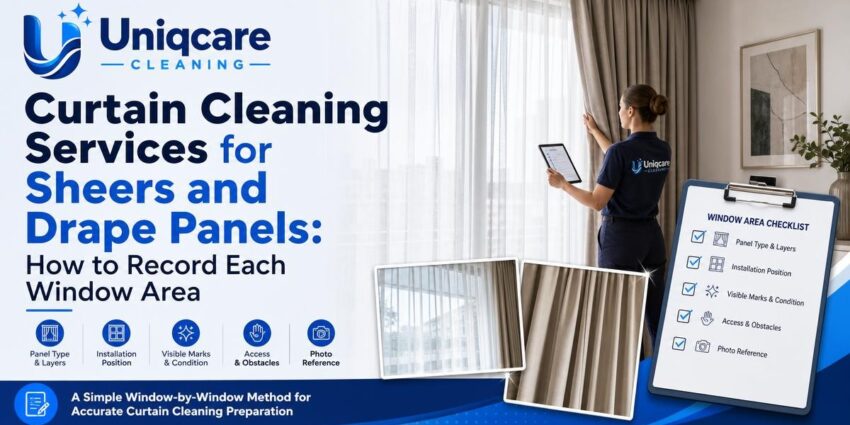
Professional curtain cleaning is easier to plan when each window is recorded separately. A simple window-by-window note helps identify whether the fabric is a sheer, a lined drape or a combination of layers, while also showing visible marks, installation details and access requirements. This preparation can give a curtain cleaning services provider clearer information before the appointment and help ensure that no panel is overlooked.
Why record each window before requesting curtain cleaning services?
Curtains in the same room may look similar but still require different handling. A living-room window might have a lightweight sheer behind a heavier drape, while a bedroom may have a single blackout-style panel or curtains installed close to furniture. The fabric, lining, size and position can vary from one window to the next.
Sending one general description such as “four curtains need cleaning” does not explain how many panels are present, whether they are still installed and which areas have visible marks. A structured record gives the cleaning team a more useful starting point. It can also help you describe the condition accurately without relying on memory during a phone call or message.
The basic window record to create
Start with one entry for every window or curtain track. Use a room name and a simple label, such as “Living room – Window 1” or “Master bedroom – Balcony door.” If two adjoining windows share one continuous track, record them together but describe the panels separately where necessary.
Take a few clear photographs from a normal standing position. Include one full view of the window and closer images of marks, hems, pleats, hooks or difficult access points. The photographs do not replace written notes, but they make the record easier to understand.
| Record item | What to note | Why it helps |
|---|---|---|
| Room and window label | Room name, window number and approximate position | Prevents panels from different areas being confused |
| Panel type | Sheer, drape, lined panel, curtain pair or other construction | Shows that different fabrics or layers may be involved |
| Number of panels | Count individual left, right, centre or fixed panels | Provides a more accurate scope of work |
| Installation position | Installed on a track, rod, ceiling fitting or other support | Helps explain how the curtains are positioned |
| Visible marks | Dust, smudges, water marks, spots, discolouration or odour concerns | Identifies areas that may need closer assessment |
| Access conditions | Furniture, high ceilings, stairs, narrow spaces or blocked windows | Allows practical access questions to be considered early |
Step 1: Identify the panel type
Sheer panels
Sheers are usually lightweight panels that allow filtered light through. They may be made from a fine woven or net-like fabric and can appear more delicate than heavier drapes. Record whether the sheer is a single panel, a pair or several narrow panels across one track.
Note any loose threads, pulled areas, fraying edges or weakened seams. These conditions are not necessarily caused by dirt, and cleaning results can depend on the fabric’s age and condition. Pointing them out in advance creates a clearer record of the panel’s starting state.
Drape panels
Drapes are generally fuller or heavier than sheers and may include lining, pleats, hooks, eyelets or decorative headings. Record whether the drape is lined and whether the lining appears separate from the face fabric. A lined panel may need more careful assessment because different materials are joined together.
Describe the top construction if you can identify it. Useful terms include pinch pleats, wave folds, tab tops, eyelets and rod pockets. If you are unsure, take a close photograph of the heading rather than guessing the construction.
Layered window treatments
For sheer and drape cleaning, list each layer separately. For example, “one white sheer pair behind two beige lined drapes” is more useful than “double curtains.” Also note whether both layers move on separate tracks or whether one layer is fixed in place.
Layered treatments can collect dust differently. The outer drape may receive more contact from hands or nearby furniture, while the sheer may show fine dust along folds and lower edges. Recording both layers helps keep the request specific.
Step 2: Count panels and describe their arrangement
Count individual panels rather than counting windows only. A single wide curtain may be one panel, while a window with curtains that open from the centre may have two panels. A bay window or corner arrangement can contain several separate pieces even when the treatment appears continuous from across the room.
- Write the total number of sheer panels.
- Write the total number of drape panels.
- Identify fixed panels that do not move.
- Note whether panels overlap at the centre.
- Record any valance, pelmet, tieback or fabric accessory that also needs assessment.
If a panel extends to the floor, mention this. Floor-length curtains can collect dust near the hem and may brush against nearby furniture or flooring. If the lower edge touches a carpet, rug or tiled floor, include that detail in the notes.
Step 3: Record how the curtains are installed
Installation position is a practical part of the request. Note whether the curtains remain installed on a wall-mounted rod, ceiling track or another fitting. Also record whether the window is above a staircase, behind a bed, next to a large cabinet or in a narrow passage.
Do not assume that every curtain will be handled in the same way. The appropriate approach may depend on the fabric, construction and condition, as well as how the treatment is installed. Uniqcare Cleaning describes curtain cleaning with steam extraction and on-site service for curtains, sheers and drapes. The specific arrangement should still be discussed when requesting an appointment.
Useful installation questions to note
- Is the panel still hanging, or has it already been removed?
- Is the track or rod reachable from the floor?
- Is a ladder likely to be required because of the ceiling height?
- Is furniture positioned directly below or in front of the window?
- Are there fragile decorations, electronics or other items close to the treatment?
- Can the window area be reached without moving a large object?
Step 4: Describe visible marks without overpromising the result
Use plain descriptions for visible marks. “Dark marks along the lower hem,” “brown spots near the right fold” or “dust accumulation around the pleats” gives more useful information than simply writing “dirty.” If you know what caused a mark, include that information, but avoid guessing when the cause is unclear.
Common observations to record include hand marks near opening edges, dust along folds, spots near the bottom, food or drink splashes, water marks, discolouration and signs of contact with a wall or piece of furniture. If there is an odour, describe where it is noticed and whether it affects one panel or the whole window treatment.
Cleaning results can depend on the material, age, previous treatment and type of mark. A request for curtain stain removal should therefore describe the condition rather than promise that every stain will disappear. A professional assessment can help determine what may be suitable for the fabric.

Step 5: Check fabric condition before the appointment
Look closely at the seams, hems, pleats and attachment points. Older curtains may have weakened stitching, brittle backing or areas that have become thin from sunlight and repeated use. Record these observations and photograph them if they are easy to see.
Check for trims, embroidery, metallic details, glued decorations or different fabrics joined on one panel. These features may affect how the item is assessed. If a care label is present, photograph it or copy the instructions into your notes. If there is no label, simply state that the fabric information is unavailable.
Step 6: Record access and preparation requirements
Access details are especially useful for on-site curtain cleaning. A provider needs to know whether the work area is open, restricted or difficult to reach. This does not mean you need to measure every part of the room. A short description and a photograph can usually communicate the main practical concerns.
Before the cleaning visit
- Move small ornaments, lamps and loose items away from the window.
- Clear the floor below the curtains where possible.
- Identify furniture that cannot be moved and include it in the notes.
- Keep pets and children away from the immediate work area during preparation.
- Make sure the provider knows about stairs, narrow corridors or restricted entrances.
- Keep the care label, purchase information or previous cleaning details available if you have them.
Do not remove curtains, hooks or fittings unless you are comfortable doing so and the arrangement allows it. If the panels are still installed, state that clearly when making the request. The cleaning team can then discuss the practical process based on the service and the window setup.
A simple window-by-window template
You can copy the following format into a note on your phone and complete one entry for every window:
- Room and window: Write the room name and a simple window label.
- Panel type: List sheers, drapes, lined panels or other layers.
- Panel count: Count each panel separately.
- Approximate size: Note whether the panels are short, full-length, wide or unusually large.
- Installation: Record rod, track, ceiling fitting, fixed panel or removed panel.
- Visible condition: Describe marks, dust, odour, fading, loose threads or damaged areas.
- Access: Mention furniture, height, stairs, narrow spaces or restricted working room.
- Photographs: Attach a full view and close-ups of important details.
For example, an entry might read: “Living room – Window 2. One white sheer pair and two grey lined drape panels. All remain installed on separate tracks. Dust along lower hems and a dark mark on the right drape. Sofa is directly below the window. Full-height glass door beside the window.” This gives a cleaning provider a practical overview without using technical terms you may not know.
How to request a clear service discussion
When contacting a curtain cleaning services provider, send the completed notes and photographs together. State the number of windows, total panel types and whether the curtains are still installed. Mention the most noticeable concern first, such as visible marks, dust, an odour or difficult access.
Ask what information the provider needs before confirming the appointment. You may also ask how the fabric and lining will be assessed, whether the service is suitable for the stated construction and what preparation is expected from you. These questions are more useful than choosing a method based only on the word “steam” or on the appearance of a neighbouring curtain.
Uniqcare Cleaning provides professional deep-cleaning services for residential and commercial clients and lists curtain cleaning among its services. Its curtain service information describes steam extraction and on-site cleaning for curtains, sheers and drapes. Customers in Kuala Lumpur, Selangor, Putrajaya and Cyberjaya can provide the window record when discussing their requirements.
Common recording mistakes to avoid
- Counting windows instead of panels: One window may contain several separate pieces.
- Combining sheers and drapes into one description: List each layer and its condition.
- Ignoring the top and bottom: Pleats, headings and hems often need separate inspection.
- Describing every mark as a stain: Some changes may be fading, water marks or fabric wear.
- Leaving out access problems: A blocked or high window can affect preparation.
- Removing labels or fittings before asking: Keep useful fabric and installation information available.
- Using only one distant photograph: Include close-ups of marks and construction details.
Final checklist before booking
Review the record once more before sending it. Confirm that every window has a label, every layer has been counted and the most visible marks have been described. Check that photographs are attached and that access restrictions are included. If you are unsure about the fabric or construction, say so instead of making an assumption.
A careful record does not guarantee a particular cleaning result, but it creates a more accurate starting point for discussion. It helps the provider understand the scope, helps you identify which panels matter most and makes the appointment preparation more organised.
Frequently asked questions
Should sheers and drapes be listed separately?
Yes. Record sheers and drapes as separate layers, including the number of panels and their visible condition. Different fabrics, linings and construction details may need different assessment.
Do I need to remove curtains before requesting cleaning?
Not necessarily. State whether the curtains are still installed or already removed. The appropriate arrangement depends on the service, fabric, fittings and access conditions.
What photographs are useful for curtain cleaning services?
Take one full view of each window and close-ups of marks, hems, pleats, headings, labels and difficult access points. Clear photographs help explain details that may be hard to describe in a message.
What should I record if I do not know the fabric type?
Write that the fabric type is unknown and photograph the panel, care label and construction. Avoid guessing, particularly when the curtain has lining, trims or delicate decorative details.
Can visible stains always be removed?
No result should be assumed in advance. The outcome can depend on the material, age, previous treatment, condition and type of mark. Describe the stain or discolouration so it can be assessed appropriately.
What access information should I provide for on-site curtain cleaning?
Mention high ceilings, stairs, furniture below the window, narrow spaces, blocked tracks and items that cannot be moved. A full-room photograph can help show the working area.
Where does Uniqcare Cleaning provide curtain cleaning?
Uniqcare Cleaning lists Kuala Lumpur, Selangor, Putrajaya and Cyberjaya among its service regions. Confirm availability and the details of your window arrangement when making an enquiry.