
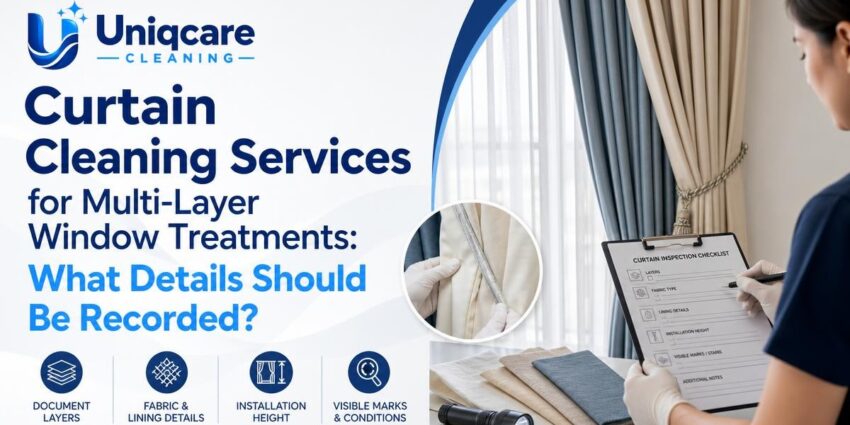
Arranging curtain cleaning services for a multi-layer window treatment requires more than describing it as “curtains.” A typical window may include a sheer, a heavier drape, a lining, separate tracks or rods and decorative features that need different handling. Recording these details before requesting a professional assessment gives the cleaning team a clearer picture of the work and helps identify questions about access, fabric care and visible marks.
Why detailed curtain information matters
Multi-layer window treatments are not always made from the same material or installed in the same way. A lightweight sheer may sit behind a lined blackout drape, while another window may have several panels with different textures, headings or decorative trims. Treating every layer as one item can leave important information out of the initial discussion.
Good records also create a useful reference for the homeowner, tenant, office manager or facilities representative. They make it easier to explain which panels need attention, where marks are located and whether the curtains are still installed. This is especially helpful when several windows look similar but have different fabrics or levels of soiling.
Cleaning suitability depends on the material and condition
Fabric type, construction, age and previous treatment can influence how a curtain should be approached. A visible mark may be caused by dust, handling, food, moisture or another source, but its final response can vary according to the fibre and how long it has been present. No cleaning method should be assumed suitable for every layer without considering the actual material and condition.
Uniqcare Cleaning lists professional curtain cleaning using steam extraction and describes on-site cleaning for curtains, sheers and drapes. The information recorded before arranging service helps the provider understand the installation and discuss the appropriate approach for the specific window treatment.
The essential details to record
Before contacting a curtain cleaning provider, walk through each room and record the information below. Photographs can support the written notes, particularly when there are multiple layers, high windows or marks that may be difficult to describe by phone.
| Detail to record | What to note | Why it helps |
|---|---|---|
| Window or room | Room name, window position and number of panels | Prevents similar windows from being confused |
| Layers | Sheer, main drape, blackout layer, lining or valance | Shows whether different materials may need separate consideration |
| Fabric | Known fibre, texture, colour and pattern | Provides useful care information before assessment |
| Installation | Track, rod, hooks, rings and whether the panels remain installed | Helps clarify access and handling requirements |
| Height | Approximate ceiling height or position of the curtain track | Allows access conditions to be discussed in advance |
| Visible marks | Location, appearance, likely source and approximate age | Gives the cleaner a clearer starting point for assessment |
| Previous care | Past washing, repairs, alterations or spot treatment | Identifies possible changes in the fabric or finish |
1. Record every layer separately
Start by listing the layers in the order they appear from the room side toward the window. For example, a window may have a decorative front drape, a lining behind it and a sheer nearest the glass. Another may have two independent drapes that meet in the centre without a sheer. Write down the arrangement rather than relying on a general description such as “double curtains.”
For each layer, note whether it covers the full window, is split into panels or is fixed in place. Include valances, pelmets, tiebacks or fabric sections attached to the treatment if they are also intended for cleaning. These pieces may collect dust and may be made from a different fabric than the main curtains.
Separate sheers from heavier drapes
Sheers are usually lighter and more transparent than the front drapes, but appearance alone does not identify their exact fibre or construction. Record the sheer as its own item, including its colour, pattern, number of panels and whether it is gathered, pleated or fitted to a separate track.
Heavier drapes should also be described separately. Note whether they are lined, interlined, blackout-style or unlined if this is known. This information is particularly relevant when arranging sheer and drape cleaning for the same window, because the two layers may have different care considerations.
2. Identify the fabric and lining details
If a care label is present, record the information or take a clear photograph of it. Look for the stated fibre, cleaning instructions and any warnings about heat, moisture or removal. If there is no label, do not guess that a fabric is cotton, polyester, linen, silk or another material based only on its appearance. Instead, describe what is known and note that the fabric type is unconfirmed.
Texture is also useful to record. Mention whether the surface is smooth, velvet-like, woven, embroidered, printed, textured or coated. Include details such as metallic threads, beads, sequins, embroidery, flocking or glued decoration. These features may be more sensitive than the main fabric and should be brought to the provider’s attention before cleaning is arranged.
Document lining and blackout construction
A lining is a separate functional layer sewn behind the face fabric. It may be plain, padded, thermal-looking or designed to block light. Record whether the lining is attached across the full panel, partially attached or removable. Also note any rippling, separation, fraying or loose stitching.
Blackout or coated materials should be described carefully without assuming what treatment they require. A coating may not be visible from the room side, and it may have changed over time. If the curtains have become stiff, sticky, cracked or uneven at the back, include that observation and photograph it where possible.
3. Measure or estimate the installation height
Installation height affects how the cleaning visit may need to be planned. Record whether the track or rod is close to the ceiling, above a staircase, over furniture or in another difficult-to-reach position. An approximate height is useful even if you cannot measure it precisely.
Also note the access route. Include narrow corridors, high floors, restricted parking, locked rooms, office access procedures or furniture that cannot easily be moved. These are not fabric details, but they help create a more accurate picture of the work environment. For curtains that are still hanging, clearly state that they are installed rather than removed and packed away.
Record the hardware
Look at how each panel is attached. Common observations include a ceiling track, wall-mounted rod, hooks, gliders, rings, tabs, pinch pleats, wave headings or eyelets. You do not need to identify the hardware perfectly; a photograph and a simple description are often enough.
Check whether the track moves smoothly and whether any hooks, rings or gliders are missing. Record loose brackets, bent sections or damaged rails before service. This separates pre-existing hardware issues from any concern that may arise later and gives the provider an opportunity to discuss handling limitations.
4. Describe visible marks accurately
Record marks by location rather than using a broad statement such as “the curtains are dirty.” For example, identify a mark on the lower right corner of the front panel, dust along the top fold or discolouration near the window edge. Note whether the mark is dry, oily, sticky, damp-looking, faded or associated with an odour.
If you know what caused the mark, include that information, but separate facts from guesses. “Food was spilled during an event” is more useful than simply calling it a stain. If the source is unknown, say so. Avoid applying household chemicals or aggressive spot treatments just before professional cleaning, because an unrecorded product may alter the fabric or leave a second mark.
Use photographs as supporting records
Take one photograph of the full window and closer photographs of specific marks. Include the surrounding fabric in close-up images so the location is clear. For high windows, photograph from a safe position rather than climbing furniture or using an unstable ladder.
Date the photographs if possible and label them by room or window. In an office or commercial space, a simple file name such as “meeting room left sheer” can be more useful than a collection of unnamed images. Keep the original images until the cleaning discussion and inspection are complete.

5. Note age, previous cleaning and repairs
Record the approximate age of the curtains if it is known. Older fabric may have faded unevenly, become brittle or changed shape through use and exposure to sunlight. Age does not automatically mean that professional cleaning is unsuitable, but it is relevant information for an assessment.
Write down previous cleaning, washing or steam treatment, including any known shrinkage, colour change, bleeding, distortion or water marks. Mention repairs such as replaced hems, patched sections, altered lengths and loose seams. If a curtain was previously cleaned while hanging, include that detail when known.
Check for pre-existing damage
Before arranging service, inspect hems, pleats, seams, hooks, heading tape and lining edges. Look for tears, pulled threads, weakened stitching, missing fasteners and areas where the fabric has separated from the hardware. Record these conditions with photographs.
This inspection is not a promise that every issue will be repaired or resolved through cleaning. Its purpose is to provide an honest starting record. Cleaning can change the appearance of a fabric that is already weakened, so pre-existing damage should be discussed before work begins.
6. Record the room and service conditions
For homes, note which rooms contain the curtains and whether children, pets, furnishings or other household activities may affect access. For offices and commercial premises, list the number of windows, room names and any preferred access arrangements. A simple room-by-room schedule is easier to check than a single total count.
Also mention whether the windows are near desks, sofas, beds, display items, electrical equipment or sensitive flooring. This does not determine the cleaning method, but it helps the customer and provider discuss preparation. If the curtains are to be cleaned on-site, identify items that may need to be moved or protected before the visit.
Include timing and access restrictions
Record building access hours, security requirements, lift restrictions and any times when a room must remain available. Do not assume that a residential or commercial site has the same access conditions as an empty room. Providing this information early can reduce avoidable scheduling questions.
Uniqcare Cleaning states that it serves residential and commercial clients in Kuala Lumpur, Selangor, Putrajaya and Cyberjaya, and describes on-site or mobile cleaning for selected services including curtain cleaning. When requesting information, provide the property location and explain the installation conditions so the service discussion reflects the actual site.
A practical curtain-cleaning record sheet
You can create one record for each window using the following headings. The aim is not to produce a technical report. It is to make the relevant facts easy to review before arranging professional curtain cleaning.
- Room or area: Identify the room and window position.
- Number of panels: Count the panels in each layer.
- Layer order: List the sheer, drape, lining, blackout layer or decorative section.
- Fabric description: Record the label information, texture, colour, pattern and special decoration.
- Hardware: Note the rod, track, hooks, rings and heading style.
- Installation: State whether the curtains are hanging, removed or partly removed.
- Height and access: Estimate the track height and mention obstacles or restrictions.
- Visible marks: Describe the location, appearance, source if known and approximate age.
- Condition: Note fading, tears, loose seams, fraying, odour or lining damage.
- Previous care: Add known washing, steam cleaning, repairs or spot treatments.
- Photographs: Match full-window and close-up images to the written record.
Questions to ask before booking curtain cleaning services
Once the details are recorded, share the relevant information with the cleaning provider and ask what needs to happen next. Useful questions should relate to the specific installation rather than assuming that one process applies to all curtains.
- Can the provider assess several layers separately?
- Should the sheers and heavier drapes be discussed as different items?
- Does the service description cover curtains, sheers and drapes that remain installed?
- What information is needed about fabric labels, linings and decorative features?
- How should existing tears, loose hooks or weakened seams be recorded?
- What preparation is needed around furniture, flooring or office equipment?
- Should any uncertain stain or previous spot treatment be pointed out during the assessment?
These questions do not guarantee a particular cleaning result. They help establish what is known before work is arranged and allow the provider to identify information that may require an inspection or further discussion.
How Uniqcare Cleaning can help with curtain cleaning
Uniqcare Cleaning provides professional deep-cleaning services for homes, offices and commercial spaces. Its listed curtain service uses steam extraction and describes on-site cleaning for curtains, sheers and drapes. Customers can prepare a room-by-room record before requesting details about the service and the specific window treatment.
The company serves Kuala Lumpur, Selangor, Putrajaya and Cyberjaya. When contacting a provider, include the number of windows, layer arrangement, fabric information, installation height, visible marks and access conditions. This gives the conversation a practical starting point without assuming that every fabric or stain will respond in the same way.
Frequently asked questions
What should I record before arranging curtain cleaning services?
Record the room, number of panels, layers, fabric and lining details, installation height, hardware, visible marks, previous cleaning and any existing damage. Photographs are useful supporting records.
Should sheers and drapes be listed separately?
Yes. Sheers and heavier drapes may differ in fabric, construction and condition. Listing them separately gives the provider clearer information for the service discussion.
Do I need to know the exact fabric type?
No. If the fibre is unknown, describe the texture, colour, pattern and any care label information. Do not guess the material; state that it is unconfirmed.
Why is installation height important?
Height helps explain access conditions, especially when curtains are near the ceiling, above furniture or in a difficult-to-reach area. It also helps clarify whether the panels are still hanging.
How should I document curtain stains?
Describe the location, appearance, likely source if known and approximate age. Take a close-up photograph that also shows the mark’s position on the full panel.
Can existing tears or loose seams be cleaned?
Existing damage should be recorded and discussed before cleaning. Cleaning is not the same as fabric repair, and the condition of a weakened area may affect how it should be handled.
Does Uniqcare Cleaning offer on-site curtain cleaning?
Uniqcare Cleaning describes on-site or mobile cleaning for selected services, including curtain cleaning, and lists professional cleaning for curtains, sheers and drapes. Confirm the arrangements for the specific installation when making an enquiry.