

Arranging rug steam cleaning for a large movable rug is easier when you prepare the right information first. Size, fibre or material, backing, visible stains, furniture placement and access can all affect how a professional cleaning service assesses the rug. Confirming these details before booking helps the cleaner understand the job and helps you decide whether a steam-based or other deep-cleaning method is suitable.
Why large movable rugs need advance planning
A large area rug may be movable in theory but difficult to handle in practice. It may sit beneath a sofa, dining table or bed, or be positioned in a room with narrow doorways and limited working space. Once cleaning begins, the rug may also need room around it for equipment, inspection and careful handling.
Unlike a small mat that one person can easily lift, a large rug can be heavy when it contains dense fibres, a thick pile or accumulated soil. Some rugs also have a separate backing, fringe or delicate surface that requires a more cautious approach. A brief conversation before service gives the cleaning provider useful context rather than leaving important decisions until equipment is already at the property.
Information to confirm before booking rug steam cleaning
Before requesting a quotation or appointment, gather the basic details below. You do not need to identify every fibre perfectly, but any information from the manufacturer’s label, purchase documents or previous care instructions can be helpful.
| Detail to confirm | Useful information to provide | Why it matters |
|---|---|---|
| Rug dimensions | Length, width and approximate thickness | Helps the provider understand the size of the work area and handling requirements |
| Material and construction | Fibre type, pile height, backing, fringe or special finish | Different materials may respond differently to moisture, agitation and heat |
| Visible condition | Stains, discoloration, odour, wear, shedding, loose edges or water damage | Allows the cleaner to assess likely challenges and discuss limitations |
| Placement | Room, furniture on top, floor type and whether the rug can be moved | Determines preparation needs and available working space |
| Access | Parking, stairs, lifts, corridors, door widths and building rules | Helps plan equipment movement and access to the rug |
| Previous treatment | DIY products, earlier cleaning, repairs or stain treatment | Previous products or repairs may affect the cleaning assessment |
1. Measure the rug and describe its construction
Size and thickness
Measure the rug at its longest and widest points. If it is rolled, folded or partly hidden under furniture, estimate the full dimensions and mention that the measurement is approximate. It is also useful to describe whether the rug is thin and flat, medium pile or thick and cushioned.
Size does not by itself determine whether a rug can be cleaned in place or moved elsewhere. However, it gives the provider an early indication of the surface involved and whether the team will need to work around furnishings. If the rug is unusually heavy, say so rather than assuming the cleaner will discover this on arrival.
Material, backing and finishing details
Check for a sewn-in care label or manufacturer’s instructions. Note whether the rug appears to be made from a synthetic fibre, wool-like material, cotton, jute, viscose or another fibre. If you are unsure, simply state that the material is unknown and send clear photographs when requesting advice.
Also mention rubber, latex, foam or fabric backing, as well as fringes, tassels, decorative stitching, raised patterns and repaired areas. These details are relevant because the surface, backing and edges may not all respond in the same way to moisture or mechanical cleaning.
2. Record the rug’s visible condition
A professional cleaner should know what you want addressed, but it is helpful to describe the condition accurately rather than using one broad term such as “dirty.” Walk around the rug in good light and make a short list of what you can see.
- Food, drink, mud, grease or pet-related marks
- Dark traffic areas or general dullness
- Fading, colour variation or discolouration
- Loose threads, worn patches, tears or lifted edges
- Fringe tangling, shedding or backing separation
- Dampness, previous water exposure or persistent odour
Take photographs from a distance and close to the affected areas. Include the whole rug, its edges and any care label. Images cannot replace an in-person assessment, but they can help a provider understand the starting condition before discussing rug carpet cleaning.
Be realistic about stains and discolouration
Cleaning can improve the appearance of many rugs, but a stain is not always a removable layer of dirt. Some marks may have changed the colour of the fibre, damaged the pile or become difficult to separate from the original dye. Previous household chemicals may also have altered the affected area.
When discussing a stain, explain what caused it if you know, when it occurred and whether anyone has already treated it. Avoid applying another strong product immediately before professional service, because the cleaner needs to know what substances may already be present.
3. Confirm whether the rug can be moved
The phrase “movable rug” can describe several different situations. A rug may be loose on the floor but trapped under heavy furniture. It may be light enough to lift but too large to carry safely through a narrow hallway. It may also be attached to an underlay that needs to be handled separately.
Tell the provider whether the rug is fully accessible, partly covered or fixed by furniture. Ask who is expected to move tables, chairs, sofas or other items. Unless a service specifically confirms that furniture moving is included, do not assume that the cleaning team will dismantle furniture or remove heavy objects.
Prepare the room carefully
Before the appointment, remove small decorative items, toys, loose cables and breakable objects from the rug and the surrounding area. If possible, create a clear route from the entrance to the room. Protect items that cannot be moved and advise the cleaner about anything fragile or unstable nearby.
For an office or commercial space, confirm whether the room can be closed temporarily and whether staff need to clear desks, chairs or display items. For a home, consider how people and pets will avoid the work area while cleaning is taking place.
4. Check access before the cleaning date
Access is often overlooked when owners arrange rug steam cleaning. A large rug and cleaning equipment may need to pass through gates, lifts, staircases, corridors and doorways. Building management may also have rules about parking, service entrances, working hours or water use.
Share practical information in advance, including the floor level, lift availability, stair access, narrow turns and approximate doorway width. Mention if parking is some distance from the entrance. These details help the provider plan the visit and identify any access issue before the appointment.
| Access question | What the owner should check |
|---|---|
| Can the team park nearby? | Identify the usual entrance, loading area or parking restrictions. |
| Is there a lift? | Check whether the lift is available, large enough and subject to booking rules. |
| Are there stairs or tight turns? | Describe the route from the entrance to the room where the rug is located. |
| Can the main door open fully? | Look for narrow doorways, security gates or furniture blocking the route. |
| Are there building restrictions? | Ask management about service hours, visitor registration and equipment access. |
5. Ask what “steam cleaning” means for the rug
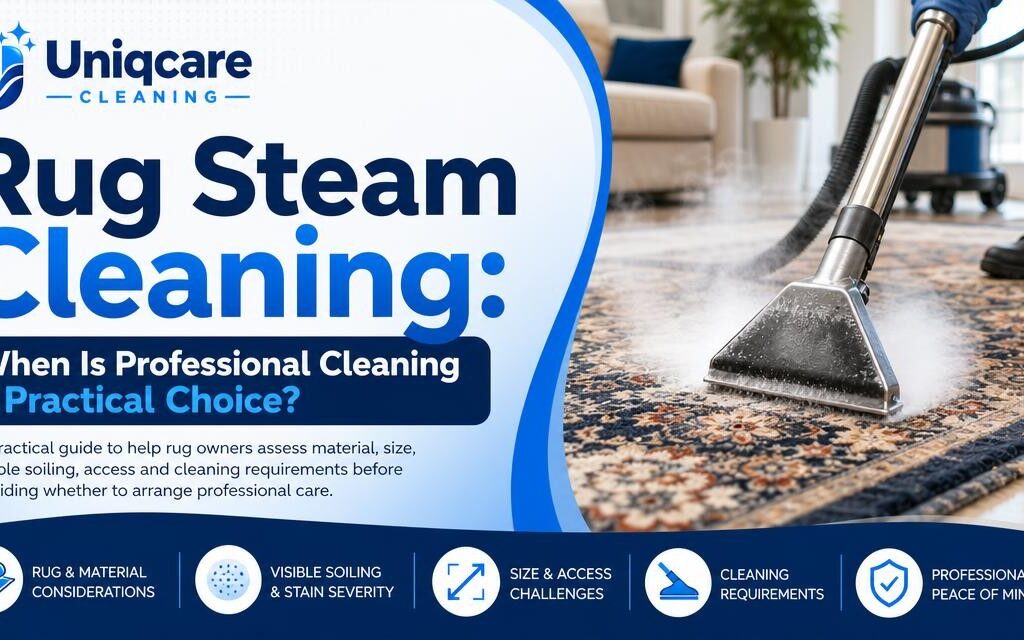
People often use “steam cleaning” as a general term for deep carpet or rug cleaning. The actual process may involve inspection, vacuuming, treatment of selected spots, moisture application, agitation and extraction. The appropriate approach depends on the rug’s material, construction and condition.
When speaking with a provider, ask what method they recommend for your specific rug and whether the work is performed in place or requires another arrangement. You can also ask how the cleaner will assess colour stability, backing and delicate details. These questions are more useful than choosing a service based only on the word “steam.”
Questions worth asking before approval
- Will the rug be inspected before cleaning begins?
- Is the proposed method suitable for the stated material and backing?
- Will the cleaner discuss visible damage or sensitive areas first?
- Does the service include moving furniture, or must the room be prepared beforehand?
- How should the room be kept clear during and after cleaning?
- Are there any concerns about fringe, loose edges, colour transfer or backing?
A clear answer may be that the rug needs a different cleaning method or further assessment. That is preferable to assuming that the same process is suitable for every area rug.
6. Discuss drying and use of the room
Moisture management is an important part of any cleaning plan involving a rug. Before booking, ask what the owner should do with furniture and when normal use of the area can resume. The answer can depend on the rug, the amount of moisture used, room ventilation and local conditions.
Do not place furniture, storage boxes or decorative items back on the rug until the cleaning provider says the area is ready. Keep children and pets away from the work zone as advised. If the rug feels unusually damp, develops a new issue or has a strong persistent odour after service, contact the provider promptly so the condition can be reviewed.
When professional rug carpet cleaning may be useful
Professional cleaning can be worth considering when routine vacuuming no longer addresses embedded soil, the rug has visible traffic marks, or a spill has affected a large area. It may also be useful before moving into a new home, after renovation dust, or when a large rug has been in a busy living or office space for an extended period.
However, cleaning is not a substitute for repair or replacement in every situation. A rug with major fibre loss, extensive backing failure, severe colour damage or prolonged water exposure may need specialist advice before any wet process is considered. Describe these concerns openly when requesting a professional carpet cleaning service.
A practical pre-service checklist
Use this checklist before confirming an appointment with Uniqcare Cleaning or another professional provider:
- Measure the rug’s length, width and approximate thickness.
- Photograph the full rug, edges, backing and care label.
- Identify the material if known, or state that it is unknown.
- List stains, odours, damp areas, wear and previous treatments.
- Confirm whether furniture is covering part of the rug.
- Ask who will move furniture and what must be removed beforehand.
- Describe stairs, lifts, narrow doors, parking and building requirements.
- Ask which cleaning method is recommended for the rug’s construction.
- Discuss post-cleaning access and when furniture can return.
Choosing a suitable cleaning conversation
The most useful booking discussion is specific to the rug rather than based on size alone. A large movable rug may be suitable for professional deep cleaning, but the final approach should consider its material, construction, condition and surroundings. Providing accurate information gives the cleaner a better basis for recommending the next step.
Uniqcare Cleaning provides professional carpet cleaning for homes, offices and commercial spaces, including area rugs, with deep-cleaning methods such as hot water extraction and steam cleaning listed among its services. The company serves Kuala Lumpur, Selangor, Putrajaya and Cyberjaya. Owners can describe the rug and access conditions when making an enquiry so the service can be discussed according to the particular cleaning requirements.
Frequently asked questions
Can every large rug receive rug steam cleaning?
No. Suitability depends on the rug’s fibre, backing, construction, condition and previous treatment. A professional assessment should come before selecting a cleaning method.
Should I move all furniture before the cleaner arrives?
Ask the provider what preparation is expected. Small items should usually be cleared from the work area, while heavy furniture may require separate arrangements unless moving it is specifically included.
What if I do not know the rug’s material?
Tell the provider that the material is unknown and send photographs of the surface, backing and care label. Avoid guessing if the rug has unusual fibres, fringe or decorative details.
Should I treat stains myself before professional cleaning?
It is better to disclose the stain and any previous treatment first. Applying several products can complicate assessment and may affect the rug’s colour or fibres.
Does steam cleaning guarantee complete stain removal?
No. Results depend on the type and age of the stain, the rug’s material, previous treatment and the extent of any fibre or colour damage. A cleaner should discuss likely limitations rather than promise the same result for every mark.
What access details should I provide for a large rug?
Share the floor level, lift or stair access, doorway restrictions, parking arrangements and any building rules. This helps the provider plan how the rug and equipment will reach the work area.