
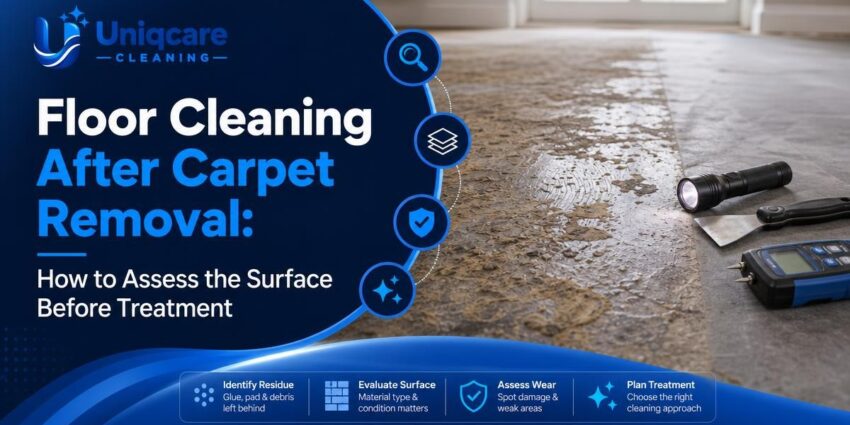
Floor cleaning after carpet removal should begin with an assessment, not simply a stronger cleaning product or more aggressive scrubbing. Once an old carpet has been lifted, the exposed surface may show adhesive residue, discolouration, scratches or wear that was hidden for years. Identifying the flooring material and the condition of the surface helps determine whether the next step should be residue removal, ordinary cleaning, polishing or a more careful restoration approach.
Why the floor needs to be assessed after carpet removal
Removing carpet reveals more than the floor itself. Adhesive may remain in patches, strips or a thin film, depending on how the carpet was installed and how it was removed. Dust, backing material and accumulated dirt can also be left behind. In some rooms, the area under the carpet may look noticeably different from the exposed border because the two sections have experienced different levels of foot traffic, sunlight and cleaning.
These conditions affect the order of work. Cleaning before identifying the residue can spread softened adhesive or leave a surface that is still unsuitable for polishing. Conversely, treating a floor as though it only needs glue removal may overlook scratches, dullness or damage that requires a separate decision. A short inspection makes the treatment more controlled and helps set realistic expectations about the final appearance.
First identify the exposed flooring material
The same residue-removal method is not suitable for every floor. Tile, terrazzo, marble, hardwood, laminate, vinyl and epoxy each have different surface characteristics. Some are relatively resistant to moisture and mechanical cleaning, while others can be affected by excess water, unsuitable chemicals or abrasive action.
If the flooring is not immediately recognisable, check any available renovation records, product information or spare materials before treatment. Also look at the surface pattern, joints, sheen and edges. An assessment should distinguish between a hard floor covering and a finish applied to that covering, because a mark may be in the material itself or only in its protective surface.
| Floor type | What to look for after carpet removal | Assessment consideration |
|---|---|---|
| Tile | Adhesive around joints, uneven dullness or dirt in textured areas | Check whether residue is on the tile face, in grout lines or both. |
| Terrazzo | Glue film, traffic wear and a loss of surface sheen | Determine whether cleaning is sufficient or whether polishing is appropriate. |
| Marble | Residue, scratches, dull patches or changes in appearance | Use a material-sensitive assessment before any abrasive treatment. |
| Hardwood | Adhesive, finish wear, marks and possible colour variation | Protect the timber and finish from unsuitable moisture or scraping. |
| Laminate or vinyl | Sticky residue, scuffing, lifted edges or surface pattern changes | Check the condition of the wear layer and avoid treating damage as dirt. |
| Epoxy | Adhesive film, scuffs or changes in gloss | Assess whether the coating is intact before selecting a cleaning method. |
Look for adhesive residue before ordinary floor cleaning
Carpet adhesive can appear as thick patches, narrow lines, tacky areas or a hazy film. It may be concentrated where the carpet edges, seams or fixing points were located. Some residue is easy to see, while a thin layer becomes more obvious when light reflects across the floor or when dust sticks to it.
Signs that glue removal is needed
- The surface feels sticky or grabs a cloth, mop or shoe.
- Raised strips or hard ridges remain where adhesive was applied.
- Dust collects in lines or patches that do not respond to normal cleaning.
- The exposed floor has an uneven sheen after loose dirt is removed.
- A scraper catches on residue, but the surrounding floor appears sound.
Do not assume that every dark mark is glue. It may be embedded dirt, a change in colour, a damaged finish or a shadow from the former carpet edge. A small test area can help distinguish surface residue from permanent discolouration, but testing should be carried out carefully and in an inconspicuous location. Aggressive scraping or an unsuitable solvent can create a larger problem than the original adhesive.
Separate residue, dirt and surface wear
After carpet removal, several conditions can appear together. Adhesive is a material left on the floor, dirt is contamination on or in the surface, and wear is a change caused by use or damage. They may look similar under poor lighting, but they require different responses.
| Condition | Typical visual or physical clue | Likely next question |
|---|---|---|
| Loose dirt | Dust, soil or debris that lifts with careful vacuuming or wiping | Can routine floor cleaning restore the appearance? |
| Adhesive residue | Sticky, raised or firmly bonded material in specific areas | Does the floor need carpet glue removal before cleaning? |
| Discolouration | A colour difference remains after surface residue is removed | Is the change in the floor material or its finish? |
| Scratches or abrasion | Lines or dull areas that remain clean but reflect light differently | Would polishing or another restoration step be suitable? |
| Loose or damaged covering | Lifting, movement, cracks or broken edges | Should repair or replacement be considered before cleaning? |
This distinction matters because cleaning cannot correct every visible defect. A floor may become cleaner while still showing age, colour variation or scratches. Clear communication about what is soil, what is residue and what is existing wear helps prevent unrealistic expectations.
Check the condition of the surface before treatment
Inspect the entire exposed area
Look across the room rather than focusing only on the most obvious glue patch. Note the condition near walls, doorways, furniture positions and carpet seams. These areas can reveal differences in wear and help show whether the floor has a consistent finish. Photographing or recording the condition before work can also provide a useful reference when the treatment is complete.
Check for changes in level and texture
Run a visual inspection across the surface and identify raised residue, depressions, rough patches and uneven joints. A floor that feels uneven may need residue removal before any polishing or finishing work. On tiled surfaces, grout may require separate attention from the tile face. On timber, laminate or vinyl, a mark may indicate damage to the finish rather than a deposit sitting on top.
Consider moisture sensitivity
Some flooring materials should not be saturated during cleaning. Water or cleaning solution can move into joints, edges or damaged areas. This is particularly relevant where the floor covering has lifted, cracked or lost its protective finish. The assessment should therefore consider not only what will remove the residue, but also how much moisture and agitation the surface can reasonably tolerate.

When floor surface polishing after glue removal may be considered
Floor surface polishing after glue removal is a separate consideration from removing the adhesive itself. Once the residue has been cleared, the underlying floor may still look dull, uneven or marked. Polishing may be appropriate for some surfaces listed for floor cleaning and restoration, but it should follow an inspection of the material and its condition.
Polishing is not a substitute for carpet glue removal. If adhesive remains, it can interfere with the result and may cause uneven appearance or complicate the process. The floor should first be cleared of relevant residue and cleaned sufficiently to reveal its actual condition. The final decision depends on the floor type, the condition of the finish and the appearance the customer wants to achieve.
Questions to ask before polishing
- Has all visible adhesive been removed?
- Is the dullness caused by residue, dirt or wear?
- Is the floor material suitable for the proposed treatment?
- Are scratches or colour differences permanent rather than surface soil?
- Will polishing address the visible issue, or is repair needed instead?
A sensible floor cleaning sequence after carpet removal
- Remove loose debris. Vacuum or collect carpet fibres, backing material and loose dust without spreading sticky residue.
- Identify the floor. Confirm whether the exposed surface is tile, terrazzo, marble, hardwood, laminate, vinyl, epoxy or another material.
- Map the residue. Record where glue, tacky film, raised strips or heavy deposits remain.
- Inspect for damage. Look for scratches, cracks, lifting, dullness, discolouration and uneven areas.
- Test carefully. Use a small, discreet area to evaluate the planned approach before treating the whole room.
- Complete carpet glue removal. Remove adhesive in a way that matches the flooring material and the condition of its surface.
- Clean the exposed floor. Once residue has been addressed, remove remaining dirt and cleaning residue using a suitable process.
- Reassess the finish. Decide whether ordinary cleaning is enough or whether polishing or another restoration step should be discussed.
This sequence can change when the floor shows significant damage or when the material is uncertain. In those situations, assessment should take priority over speed. The aim is to avoid replacing one visible problem with scratches, dull patches or damage caused by an unsuitable treatment.
Common mistakes to avoid
Using excessive force
Hard scraping may remove a stubborn deposit, but it can also mark the surface beneath it. Mechanical action should be appropriate for the material, especially on finished timber, resilient flooring and polished surfaces.
Applying a strong product without testing
A product that loosens adhesive on one floor may affect the finish on another. Product suitability, dwell time and the condition of the surface all matter. A small test area is safer than treating the entire room first.
Polishing before the floor is clean
Polishing over remaining glue, dust or cleaning residue can produce an uneven result. It may also make it harder to identify the original problem. Residue removal and cleaning should come before any decision about a polished finish.
Floor cleaning can remove soil and some surface residue, but it cannot guarantee that a worn finish, permanent discolouration or physical damage will disappear. A professional assessment should explain which changes may respond to cleaning and which may remain visible.
When to arrange professional floor cleaning
Professional help may be useful when adhesive covers a large area, the flooring material is uncertain, residue is firmly bonded or the floor shows mixed conditions. It is also worth seeking an assessment when the room is part of an office, rental property or commercial premises where the finished appearance matters and treatment must be planned around the existing surface.
Uniqcare Cleaning provides floor cleaning and restoration services for flooring types including hardwood, tile, terrazzo, vinyl, laminate, epoxy and marble. Its listed services also include carpet glue removal, carpet disposal and optional floor surface polishing. The appropriate service depends on the material and condition found after the carpet is removed. Uniqcare Cleaning serves customers in Kuala Lumpur, Selangor, Putrajaya and Cyberjaya.
How to prepare before requesting an assessment
- Remove movable items where practical so more of the floor can be inspected.
- Keep a small section of the removed carpet or note how it was installed if that information is available.
- Take clear photographs of adhesive, stains, scratches and uneven areas.
- Identify the approximate age and material of the flooring if known.
- Explain whether the goal is basic cleaning, residue removal, improved appearance or possible polishing.
- Ask which visible conditions may remain after treatment.
Useful information before the visit helps the cleaning provider understand the job, but an on-site assessment may still be needed before selecting a treatment. The floor underneath an old carpet often contains several separate issues, and a careful review is the best starting point for choosing the right next step.
Frequently asked questions
Can ordinary floor cleaning remove carpet glue?
Ordinary cleaning may remove loose dirt around the area, but bonded adhesive usually needs a separate carpet glue removal approach. The flooring material and residue condition should be assessed first.
Should carpet glue be removed before floor polishing?
Yes. Visible adhesive should generally be addressed before polishing is considered. Remaining residue can affect the appearance and make the polishing result uneven.
How can I tell whether a mark is glue or floor damage?
Glue may feel sticky, raised or firmly bonded, while damage may remain as a scratch, dull patch or colour change after the surface is clean. A discreet test and professional inspection can help distinguish them.
Is every floor suitable for polishing after carpet removal?
No. Suitability depends on the material, finish and condition of the floor. Tile, terrazzo, marble, hardwood, laminate, vinyl and epoxy may require different treatment decisions.
Can floor cleaning restore the colour difference under an old carpet?
Cleaning may remove dirt and surface residue, but a colour difference caused by wear, sunlight or permanent change in the material may remain. The result depends on the cause of the difference.
What should I do if I do not know what type of floor is underneath?
Avoid aggressive scraping or untested chemicals. Photograph the surface, check available property records and arrange an assessment so the treatment can be matched to the flooring material.