
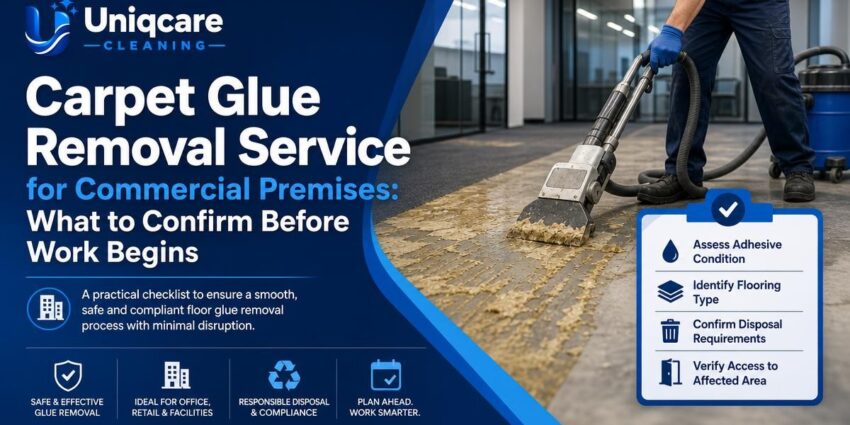
Arranging a carpet glue removal service for a commercial premises involves more than lifting an old carpet. The adhesive may be bonded to concrete, tile, vinyl, timber or another flooring surface, while furniture, access restrictions and disposal arrangements can affect the work. A clear pre-work discussion helps the cleaning team understand the site and helps the business prepare the area properly.
Why commercial carpet glue removal needs careful planning
When carpet is removed from an office, shop, showroom, clinic, classroom or other commercial area, adhesive often remains on the floor. Some patches may be thin and brittle, while others may be thick, strongly bonded or spread across a large section. The age and condition of the adhesive can also vary from one room to another.
The exposed flooring underneath is just as important as the glue itself. A method suitable for a sound concrete floor may not be suitable for a more delicate surface. Before work begins, the service provider needs enough information to assess the likely approach, protect surrounding areas and identify any limitations.
Uniqcare Cleaning lists carpet glue removal and disposal as a service for removing carpet adhesive from various flooring surfaces. The listed service also includes carpet disposal, with optional floor surface polishing described as an additional consideration. The exact scope should still be confirmed for the individual premises before scheduling.
Commercial carpet glue removal checklist
The following checklist can help a facilities manager, tenant, property owner or contractor prepare a useful enquiry. Photographs, floor plans and clear site notes can make the initial discussion more productive, especially when the affected area is spread across several rooms.
| Item to confirm | Information to prepare | Why it matters |
|---|---|---|
| Affected area | Rooms, approximate size and whether the adhesive is continuous or patchy | Helps establish the scope of the work |
| Adhesive condition | Hard, soft, thick, thin, flaky, tacky or heavily bonded areas | Different conditions may require different handling |
| Flooring underneath | Concrete, tile, vinyl, timber, laminate, terrazzo or another surface | Protects the substrate from unsuitable treatment |
| Items in the area | Desks, shelving, machinery, fittings and loose materials | Determines preparation and working clearance |
| Access | Loading bays, lifts, stairs, parking, security and entry times | Supports practical planning for equipment and waste |
| Disposal | Whether old carpet and removed adhesive are included in the requested scope | Avoids confusion about what happens after removal |
| Finishing needs | Cleaning, surface preparation or optional polishing after glue removal | Clarifies the condition expected at handover |
1. Describe the adhesive condition accurately
Start by explaining what is visible now. Is the carpet already fully removed, or does carpet still cover part of the floor? Are there isolated strips of glue around the perimeter, broad areas of adhesive beneath the carpet, or small remnants where the carpet has torn away? A close-up photograph and a wider room photograph can show both the texture and the scale of the problem.
Also mention whether the adhesive appears dry and hard, rubbery, sticky, powdery or uneven. These descriptions do not replace an assessment, but they give the provider useful context. Areas with old, layered or heavily bonded adhesive may need more preparation than a floor with light residue.
Information that is easy to overlook
- How long the carpet has been installed, if known.
- Whether previous removal work has already been attempted.
- Whether adhesive is present under partitions, cabinets or fixed fittings.
- Whether the floor has cracks, loose tiles, damaged boards or other visible defects.
- Whether different adhesive conditions occur in adjoining rooms.
Previous DIY scraping or contractor work should be disclosed. Scratches, gouges and uneven areas may affect what can reasonably be achieved during glue removal. It is better to identify these conditions before work starts than to treat them as part of the adhesive-removal scope.
2. Confirm the flooring type beneath the carpet
Floor glue removal is not simply a matter of separating adhesive from a removable covering. The substrate beneath it needs to be considered throughout the process. Commercial premises may contain concrete, tile, terrazzo, vinyl, timber, laminate, epoxy or other flooring materials, sometimes within the same building.
If the flooring type is uncertain, say so rather than guessing. A building manager, landlord, fit-out contractor or previous flooring installer may have relevant records. Photographs of an exposed edge can also help, although an on-site inspection may be needed for a reliable assessment.
| Flooring information | Questions to ask before work |
|---|---|
| Material | What surface is beneath the carpet, and is it the same throughout the area? |
| Condition | Are there cracks, loose sections, water damage, stains or previous repairs? |
| Desired finish | Should the result be adhesive-free only, or should the surface also be cleaned or polished? |
| Future use | Will new carpet, another floor covering or exposed flooring be installed afterwards? |
These questions are especially relevant when the floor will remain exposed. Removing adhesive may reveal colour variation, old marks, fixing holes or differences between areas that were previously covered and areas that were not. Glue removal can address the adhesive, but it does not automatically restore every pre-existing floor defect.
3. Separate carpet removal from adhesive removal
Commercial clients sometimes use “carpet removal” to describe several different tasks. These may include lifting and cutting the carpet, gathering loose pieces, removing underlay, separating adhesive from the floor and disposing of the resulting materials. Ask which parts are included in the requested carpet glue removal service.
If the carpet is still installed, confirm whether the provider is expected to remove it or whether another contractor will do so first. If the carpet has already been lifted, explain whether the old material is stacked on site, bagged, placed near an exit or still spread across the affected rooms. The more precise the description, the less likely it is that the scope will be misunderstood.
Questions about old carpet disposal
- Is collection of the old carpet included?
- Does disposal cover underlay and loose debris as well as carpet?
- Will removed material be placed in a designated waste area?
- Does the building require prior approval for waste removal?
- Who is responsible for any disposal requirements outside the agreed service scope?
Uniqcare Cleaning’s listed carpet glue removal service includes carpet disposal as part of the described offering. The precise materials, quantities and disposal arrangements should be confirmed for the site rather than assumed from a general service description.
4. Clarify the final floor condition you need
There are several possible handover expectations. A business may only need the adhesive removed before another contractor installs new flooring. Another client may want the exposed floor cleaned and prepared for immediate use. A landlord may want the area left presentable for inspection, while a retail operator may be planning a new fit-out.
Discuss the desired finish in plain language. Ask whether the scope includes loose residue, general cleaning after removal, surface preparation or optional polishing. Uniqcare Cleaning lists optional floor surface polishing with its carpet glue removal service, but polishing is not the same requirement for every floor type or every project.
A useful brief should state both the problem and the intended next step: for example, “remove carpet adhesive from the exposed floor before new flooring installation” or “remove residue and discuss whether the existing floor can be polished.”
It is also sensible to ask how pre-existing damage, discolouration or surface variation will be treated in the assessment. No cleaning process should be described as a guarantee that every mark or underlying defect will disappear, because results depend on the material and its condition.
5. Plan access to the affected area
Commercial access can be more complicated than residential access. The team may need to move through a reception area, loading bay, service lift, staircase, basement or secured floor. Some buildings restrict contractor entry to particular hours or require advance registration. Others have rules about parking, waste movement, noise or protection of shared corridors.
Provide these details before confirming the appointment. If the premises are occupied, explain how the work area will be separated from staff, visitors, customers or tenants. Identify doors, corridors and lift routes that may need protection from tools, removed carpet or floor residue.
Access details to prepare
- Building address and the most practical entry point.
- Contact person who can provide access on the day.
- Security registration, visitor passes or loading-bay rules.
- Lift dimensions or restrictions, where relevant.
- Available parking or unloading arrangements.
- Permitted working hours and any building-management requirements.
- Whether rooms can be cleared before the team arrives.
Do not assume that a large open floor is ready simply because the carpet has been removed. Desks, display units, stock, cabling and fixed equipment can reduce working space. Tell the provider what must remain in place and what can be relocated.
6. Decide how the premises will be prepared
Before a commercial carpet adhesive removal appointment, assign responsibility for clearing the area. A facilities team may move furniture, while a tenant may need approval before disconnecting equipment or removing partitions. If the floor is being prepared for a renovation, coordinate the cleaning appointment with the flooring installer and other trades.
Mark any items that must not be moved. Keep documents, stock and small equipment away from the work zone. If only part of a large office is affected, define the boundary clearly so the provider can work without uncertainty about which areas are included.
It is also useful to decide how the area will be used immediately afterwards. If the next contractor needs access, allow time for inspection and handover. If staff will return to the room, ask what condition the floor will be left in and whether additional cleaning or finishing is appropriate.
7. Confirm the written scope before work begins
A short written scope protects both sides. It does not need to be complicated, but it should identify the areas, materials and requested outcome. For a multi-room commercial job, a room-by-room list is often clearer than a single general description.
Ask the provider to confirm any exclusions or conditions that could change the work. These may include concealed adhesive beneath fixed fittings, damaged substrate, areas inaccessible without dismantling items, or finishing work that depends on the condition of the exposed floor.
| Scope point | Example wording to confirm |
|---|---|
| Location | Identify the rooms, zones or floor levels included. |
| Removal | State whether carpet, underlay, adhesive residue or all three are included. |
| Disposal | Confirm which removed materials will be collected and disposed of. |
| Surface | Record the known flooring type and any visible pre-existing damage. |
| Finishing | State whether cleaning, preparation or polishing is requested separately. |
| Access | Note entry procedures, working hours and the site contact. |
This information is particularly helpful when several parties are involved. The tenant may arrange access, the landlord may control the floor, and a separate installer may be responsible for the next stage. A shared understanding reduces delays and avoids asking the cleaning team to make decisions outside the agreed brief.
8. Questions to ask a carpet glue removal provider
When comparing or contacting a provider, focus on questions that relate to your premises rather than relying only on a general service title. A useful enquiry invites the company to assess the adhesive, flooring and access conditions together.
- Can the affected area be assessed from photographs, or is a site visit needed?
- What information is required about the flooring underneath the carpet?
- Does the requested service include removing the old carpet, or only adhesive removal?
- What carpet and related materials can be included in disposal?
- Should furniture, stock or equipment be moved before the appointment?
- Can the floor surface be discussed for cleaning or optional polishing after glue removal?
- What access, parking, building registration and working-hour details should be arranged?
- What existing damage or surface variation should be recorded before work starts?
Uniqcare Cleaning provides deep-cleaning services for residential and commercial clients and lists Kuala Lumpur, Selangor, Putrajaya and Cyberjaya among its service regions. Businesses in these areas can provide the site details above when asking about carpet glue removal and disposal. The company lists operating hours from Monday to Saturday, 8:30 to 17:00, but appointment availability and project arrangements should be confirmed directly.
Final pre-work review
Before approving the job, check that the affected areas, adhesive condition, underlying flooring, disposal needs and access arrangements have all been discussed. Confirm what the team will remove, what will remain, how the area should be prepared and whether surface polishing or another finishing step is being considered.
A well-defined brief does not guarantee that every floor will look the same after adhesive removal. Existing damage, material type and the condition of the adhesive all influence the result. It does, however, give the business and the provider a clearer basis for planning the work and assessing the floor fairly at handover.
Frequently asked questions
What does a carpet glue removal service usually address?
It addresses adhesive left on a floor after carpet removal. The exact scope may also include old carpet disposal and related finishing options, but these details should be confirmed for the premises.
Can floor glue removal be arranged if the old carpet is still installed?
It may be possible, but the provider needs to know whether carpet removal is included or will be completed by another contractor. Confirm this before scheduling.
Why does the flooring type matter?
The exposed surface may be concrete, tile, vinyl, timber, laminate, terrazzo or another material. Its condition and sensitivity affect how the adhesive can be approached and what final result is realistic.
Is old carpet disposal included in carpet glue removal?
Some service scopes include carpet disposal, while others may cover adhesive removal only. Uniqcare Cleaning lists carpet disposal with its carpet glue removal and disposal service, but the materials and arrangements should be confirmed for each project.
Should a commercial premises move furniture before the service?
Usually, the clearer and more accessible the affected floor is, the easier it is to plan the work. Confirm which items must be moved, which can remain and who is responsible for moving them.
Can the floor be polished after adhesive removal?
Floor surface polishing may be an option depending on the flooring type and condition. It should be discussed separately because removing adhesive does not automatically mean the floor is suitable for polishing.
What should a business send when requesting an assessment?
Send photographs, the premises location, approximate affected area, flooring information, adhesive condition, access restrictions and disposal requirements. These details help the provider understand the project before work begins.