
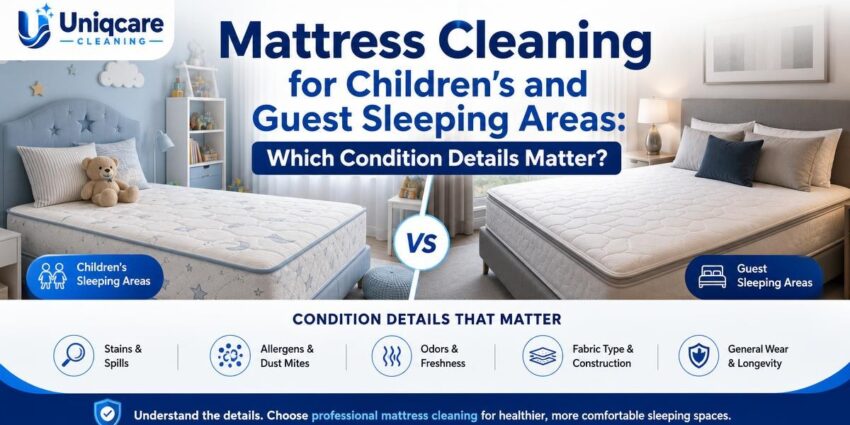
Mattress cleaning is not always the same from one sleeping area to another. A child’s mattress may have food spills, drink stains or repeated accidents, while a guest mattress may be used less often but remain closed up for long periods. Looking closely at the mattress material, usage pattern, visible marks, odours and general wear can help you decide whether routine care is enough or whether a professional assessment would be more suitable.
Why different sleeping areas need different attention
A mattress in a child’s room usually experiences frequent use and more varied contact. Children may eat or drink near the bed, play on the mattress or have occasional accidents. These situations can introduce moisture and staining into the cover and, depending on the material, deeper layers. Regular vacuuming and the use of a washable protector can help with everyday maintenance, but they do not address every condition that develops over time.
Guest mattresses follow a different pattern. They may be used only occasionally, yet long gaps between use can allow dust and stale odours to become noticeable when the room is opened again. A guest bed may also be exposed to different products, luggage or clothing than the household’s usual sleeping area. The key question is not simply how often the mattress is slept on, but what has happened to it and how it has been stored between uses.
The condition details worth checking first
Before arranging mattress cleaning, inspect each sleeping area separately. Record what you can see, smell and remember about the mattress. This gives a cleaning provider more useful information than saying only that the mattress looks dirty.
| Condition detail | Why it matters | What to record |
|---|---|---|
| Usage | Frequent use can create more accumulated soil and wear. | Who uses it, how often and whether children or guests use it. |
| Mattress construction | Materials and layers may respond differently to moisture and agitation. | Foam, spring, hybrid or other construction if known. |
| Stains | Different substances may require different treatment decisions. | Location, colour, approximate age and likely source. |
| Odour | Smells may be connected with spills, dampness or enclosed storage. | Whether the odour is localised, widespread, new or recurring. |
| Wear and damage | Weak seams, tears or sagging can affect how cleaning should be approached. | Rips, loose covers, exposed filling, sagging or broken components. |
| Previous treatment | Old products or moisture may influence the next cleaning attempt. | DIY products, washing, spot treatments or earlier services. |
Assessing a child’s mattress
Look beyond visible surface marks
Children’s mattresses often need closer inspection because the cause of a mark may not be obvious. A small patch could come from a drink, food, perspiration, colouring material or an accident. Check the top surface, edges, seams and the area around the pillow and lower body positions. Also look underneath the mattress and around the bed frame if there has been a spill, since moisture may have transferred to nearby surfaces.
Note whether the mark is fresh or has been present for some time. Older stains may have changed colour or become more difficult to identify. Repeated attempts with household products can also leave residue or cause a ring around the original spot. This does not mean cleaning cannot be attempted, but it does mean the expected result should be discussed realistically before work begins.
Consider the mattress protector and bedding history
A waterproof or washable protector can reduce the amount of liquid reaching the mattress, but it is not a guarantee that the mattress itself remains unaffected. Inspect the protector for tears, poor fitting or signs that liquid has passed around the edges. If the protector has been missing or was added only after a previous incident, mention that when requesting an assessment.
Ask how the mattress has been maintained. Has it been vacuumed regularly? Was it aired after a spill? Has bedding been changed promptly? These details help separate ordinary surface soil from a more specific cleaning concern. They can also show whether the main need is mattress cleaning, replacement of a damaged protector or attention to surrounding upholstery and flooring.
Assessing a guest mattress
Infrequent use does not mean no cleaning need
A guest mattress may appear clean because it is not used every night, but infrequent use can make condition details harder to track. A spill may have happened during a previous visit and gone unnoticed. The mattress may also have been stored under bedding for a long period, allowing odours to become more apparent when the room is reopened.
Check for yellowing, grey areas, marks near the edge and any musty or stale smell. Look at the underside if the mattress can be lifted safely, and inspect the bed base for signs of past dampness. If the guest room is closed for extended periods, note whether the room has limited ventilation or whether the mattress is covered with a non-breathable material.
Ask about recent visitors and incidents
When several people use a guest bed over time, the household may not know exactly what caused a mark. That uncertainty is useful information in itself. Tell the cleaning provider when the mattress was last used, when the mark was first noticed and whether anyone reported a spill, illness-related accident or other incident. Avoid guessing that a stain is a particular substance unless you know its source.
Guest mattresses may also be affected by pets, luggage or children visiting for a short stay. These circumstances can create different cleaning considerations, especially if there are loose fibres, pet hair, food particles or pressure marks. A clear description helps the provider decide what to inspect rather than assuming every mattress has the same condition.
Why mattress construction matters
Mattresses are not all built in the same way. Common types include innerspring, foam and hybrid designs, but the exact cover, padding and internal layers can vary. A label may identify the manufacturer and care instructions, so keep it available if possible. The material and construction can influence the cleaning approach, moisture level and drying requirements.
For example, a mattress with delicate fabric, a removable cover or exposed damage should not be treated as though it were a heavily built commercial item. Foam may retain moisture differently from a spring-based mattress, while a hybrid design can include several layers that are difficult to assess from the outside. These differences are reasons to request an evaluation rather than selecting a method based only on the mattress colour or stain size.
- Check the care label before applying any household product.
- Identify whether the cover is removable and whether it is intended to be washed.
- Look for tears, loose stitching, exposed foam or broken support components.
- Tell the provider if the mattress has been wet recently or stored in a damp environment.
- Keep records of previous cleaning products or treatments used on the surface.
Stains, odours and general wear are separate issues
Stains
Mattress stain removal depends on the substance, age, fabric and depth of the mark. A recent spill may be easier to describe and address than an old stain that has spread or changed colour. Some marks may improve without disappearing completely, particularly when the material has been permanently discoloured or damaged.
Do not scrub aggressively before an assessment. Vigorous rubbing can spread a liquid, roughen the fabric or push residue further into the material. Blotting a fresh spill with a clean absorbent cloth and following the manufacturer’s care guidance is generally more sensible than experimenting with several chemicals.
Odours
Odour can come from a spill, prolonged storage, dampness, body contact or nearby materials. Describe whether the smell is present across the whole mattress or concentrated in one area. Also mention whether it returns after airing. Odour removal should be discussed as a condition-dependent result, not an automatic promise, because the underlying source and mattress construction both matter.
Wear and damage
Cleaning cannot reverse every form of physical wear. Sagging, permanent compression, torn fabric, exposed filling and damaged seams are mattress-condition issues rather than surface-cleaning problems. Cleaning may still be considered where the mattress is structurally usable, but damage should be disclosed before work begins. A provider can then explain what can reasonably be attempted and what may remain visible.
When professional mattress cleaning may be worth considering
A professional mattress cleaning assessment can be useful when a mattress has persistent marks, an established odour, visible accumulated soil or a history of spills that household care has not resolved. It may also be helpful before a child moves into a room, after a guest stay involving a noticeable incident or when a spare mattress has been stored for a long period.
Professional mattress cleaning is not a substitute for replacing a mattress that is badly damaged, heavily deteriorated or no longer suitable for use. It is also not a way to guarantee complete removal of every stain, odour or substance. The likely outcome depends on the material, condition, age of the problem and the cleaning method considered appropriate.
How to prepare for a mattress cleaning assessment
Preparation is straightforward but useful. Remove sheets, blankets, toys and personal items from the bed. Keep the mattress label or care instructions available. If the mattress is part of a storage bed or has limited access on one side, mention this when arranging the appointment. Take clear photos of stains or damaged areas if an initial discussion is being handled remotely.
Prepare a short condition summary for each mattress. Include who uses it, how often it is used, what happened, when the problem was noticed and what products have already been applied. If the mattress is in a child’s room, state whether there have been repeated spills or accidents. For a guest room, mention how long the mattress has been unused and whether the room has ventilation concerns.
- Remove all bedding and inspect the mattress in good lighting.
- Mark the location of stains, odours or damaged seams with notes or photographs.
- Find the care label and record the mattress type if known.
- List any previous DIY treatments or cleaning services.
- Ask what result may be realistic for the specific material and condition.
- Follow the provider’s instructions about access, bedding removal and use after cleaning.
Questions to ask before choosing a service
When comparing a mattress cleaning service, focus on how clearly the provider handles condition differences. A useful conversation should cover the mattress type, the source and age of stains, moisture concerns, access, damaged areas and the expected result. Be cautious of any claim that every stain, germ, allergen or odour will be removed regardless of material and condition.
Uniqcare Cleaning lists professional mattress cleaning among its deep-cleaning services for residential and commercial clients. Homeowners can describe the sleeping area and mattress condition before requesting information about the appropriate service. The company serves Kuala Lumpur, Selangor, Putrajaya and Cyberjaya, subject to current service arrangements.
A practical decision guide for each sleeping area
| Sleeping area | Priority checks | Useful information to provide |
|---|---|---|
| Child’s everyday mattress | Spills, accidents, food marks, repeated use and protector condition. | How often incidents occur, when the latest mark appeared and previous spot treatments. |
| Child’s occasional mattress | Storage conditions, old stains, odour and bedding protection. | How long it has been unused and whether it was stored covered or exposed. |
| Guest bedroom mattress | Infrequent use, ventilation, stale odour, unknown stains and bed-base condition. | Last known use, reports from guests and when the problem was noticed. |
| Frequently shared guest or family mattress | Accumulated soil, wear, spills and differences in users. | Typical frequency of use and any known incidents involving children or pets. |
Final checklist
The most useful mattress cleaning decisions begin with accurate condition details. Usage, mattress construction, stains, odours, moisture history and physical wear all matter. A child’s mattress may need attention because of repeated small incidents, while a guest mattress may need inspection because a long period of storage has hidden or intensified a problem.
- Inspect the entire mattress, not only the sleeping surface.
- Separate visible stains from odour and structural wear.
- Do not assume a lightly used mattress is automatically clean.
- Do not promise that every mark or smell can be removed.
- Share the mattress type, care label and treatment history before service.
- Ask for a realistic assessment based on the actual condition.
Frequently asked questions
Is mattress cleaning different for a child’s mattress?
It can be. Children’s mattresses may have more frequent spills, food marks or accidents, so the source, age and location of each problem should be explained before cleaning. The mattress material and care instructions still determine the suitable approach.
Should a guest mattress be cleaned even if it is rarely used?
Infrequent use does not automatically keep a mattress clean. A guest mattress can collect dust, develop stale odours or retain an old spill, especially when covered or stored for long periods. Inspect it before expected visitors use it.
Can professional mattress cleaning remove every stain?
No result should be guaranteed in advance. Stain improvement depends on the substance, age, fabric, mattress construction and previous treatments. Some discolouration or damage may remain after cleaning.
What should I tell a mattress cleaning provider?
Share the mattress type if known, who uses it, how often it is used, the location and likely source of stains, odour history, moisture incidents, physical damage and any products already applied.
Should I scrub a fresh mattress stain before booking service?
Aggressive scrubbing can spread liquid or damage the fabric. Blot a fresh spill carefully with a clean absorbent cloth and follow the manufacturer’s care instructions instead of applying several untested products.
Can cleaning fix a sagging or damaged mattress?
Cleaning may address surface soil or some stains, but it cannot restore damaged springs, sagging support, torn fabric or permanently compressed filling. Describe these issues during the assessment so expectations remain realistic.
Does Uniqcare Cleaning provide mattress cleaning?
Yes. Mattress cleaning is listed among Uniqcare Cleaning’s professional deep-cleaning services. Customers can provide details about the sleeping area and mattress condition when asking about service arrangements in the company’s stated service regions.