
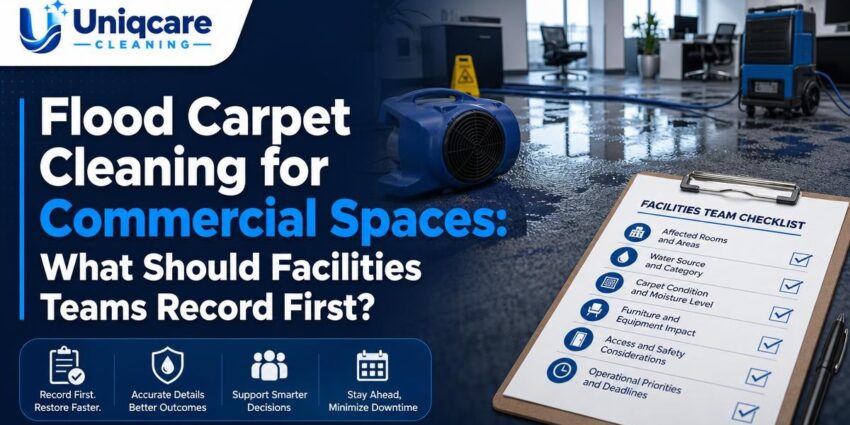
When water enters a commercial premises, facilities teams need more than a quick description such as “the carpet is flooded.” Good records help a restoration provider understand the situation before arriving, prepare suitable equipment and identify which areas need attention first. This flood carpet cleaning checklist covers the practical details to record, including affected rooms, the water source, carpet condition, furniture, access and operational priorities.
Why documentation matters before flood carpet cleaning
Commercial flooding rarely affects a single item in isolation. Water may reach carpet, underlay, skirting, furniture, partitions, stored materials and walkways at the same time. A clear record gives everyone the same starting point and helps facilities, building management, tenants, insurers and cleaning providers coordinate their next steps.
Documentation is also useful when conditions change. A room that appears lightly affected may become more difficult to use if moisture remains below the carpet surface or if furniture prevents access. Recording the initial condition, then updating it as work progresses, creates a practical timeline rather than relying on memory.
The first information to record
Start with a simple incident record. Use one line for the overall event and separate entries for each affected room, zone or tenant area. If several floors or units are involved, avoid combining them into one vague description.
| Information | What to record | Why it helps |
|---|---|---|
| Incident time | When the water was first noticed and when the source was controlled, if known | Creates a clear timeline for decisions and follow-up |
| Location | Building, floor, room, unit or named work area | Allows the team to prioritise and direct the cleaning crew |
| Water source | Known, suspected or unknown source and whether it is still active | Shows whether the area is ready for assessment or remains unsafe |
| Extent of water | Visible spread, depth if safely observable and nearby areas reached | Helps estimate the affected work zone |
| Materials affected | Carpet type if known, underlay, furniture, walls and other contents | Supports a more appropriate cleaning and restoration plan |
| Access conditions | Loading access, lifts, stairs, parking, security and restricted areas | Reduces delays when equipment and staff are arranged |
| Operational priority | Critical rooms, tenant needs, visitor areas and reopening concerns | Helps sequence work around business operations |
1. Identify every affected room and zone
Record the exact location of visible water and any nearby area that may have been reached. Include room names, floor numbers, unit numbers and landmarks such as reception, meeting rooms, corridors or server-adjacent spaces. In an open-plan office, divide the floor into practical zones instead of describing the entire floor as one area.
Note whether the water has moved under doors, across corridors or beneath furniture. Also record areas that appear dry but sit next to the affected zone. These details help a flood carpet cleaning provider understand the possible boundaries of the work without assuming that visible wetness shows the full extent.
Use a room-by-room record
- Room or zone name and floor level
- Approximate affected area
- Whether water is visible, dampness is suspected or the area has been checked
- Nearby rooms, corridors or tenant spaces that may also be affected
- Photographs showing the same room from more than one direction
Photographs should be labelled with the location and time where possible. Avoid moving heavy furniture merely to obtain a picture. The aim is to document the condition safely and consistently, not to create additional damage.
2. Record the water source and type of incident
The water source is one of the most important facts to capture. Record whether the incident followed heavy rain, an overflowing drain, a plumbing failure, a roof leak, an appliance problem or another known event. If the source is uncertain, write “unknown” rather than guessing.
Also state whether the source has been stopped and whether water is still entering the premises. Flood carpet cleaning should be arranged alongside appropriate building or maintenance action; cleaning cannot solve an active leak. Facilities teams should record who isolated or repaired the source and when that action took place, if that information is available.
- Date and time the water was discovered
- Whether the water appeared clear, cloudy, dirty or mixed with visible debris
- Whether the source was internal, external or uncertain
- Whether the water was still flowing when the area was inspected
- Any visible damage to pipes, ceilings, drains, doors or nearby fixtures
- Names of building or maintenance contacts involved in controlling the source
Do not place staff in a hazardous area to investigate the source. If there are electrical concerns, structural concerns or contaminated materials, follow the building’s emergency procedures and use qualified personnel where required.
3. Describe the carpet condition before anything is moved
Carpet condition affects the way a provider assesses the job. Record whether the carpet is loose-lay, fitted wall-to-wall, tiled or an area rug if known. Include the visible colour, pile condition, seams, edges and any pre-existing damage that can be identified before cleaning begins.
After flooding, note whether the carpet is saturated, damp at the edges, visibly soiled, stained, wrinkled, lifting or separating from the floor. Record unusual odours without assuming their cause. If the carpet has already been vacuumed, extracted, lifted or treated with a product, include that information and the approximate time.
| Carpet observation | Record specifically |
|---|---|
| Construction | Wall-to-wall carpet, carpet tile, loose carpet or rug, if known |
| Moisture condition | Wet, damp, visibly dry or not yet assessed |
| Physical condition | Wrinkling, lifting, detached edges, damaged seams or loose sections |
| Surface condition | Mud, debris, visible staining, residue or tracked dirt |
| Existing problems | Old stains, worn areas, tears or damage present before the incident, if known |
| Previous action | Water extraction, cleaning, movement or chemical treatment already attempted |
These observations do not determine whether a carpet can be salvaged. A professional assessment is still needed, especially where water has reached the underlay or flooring beneath the carpet. However, accurate notes reduce confusion and help distinguish flood-related changes from earlier wear.
4. List furniture, equipment and contents in the affected area
Furniture can hold the carpet down, restrict airflow and make parts of the floor difficult to inspect. Create an inventory of desks, chairs, cabinets, shelving, partitions, display items and other contents standing on or near the wet carpet. Record whether each item is movable, too heavy to move safely or already relocated.
Include sensitive business contents such as paper files, electrical equipment, stock and tenant property. Do not make assumptions about who owns an item. A simple owner or department field can help facilities teams coordinate permissions before furniture is shifted or cleaning begins.
Furniture and contents checklist
- Item description and approximate location
- Owner, department or tenant responsible for the item
- Whether the item is wet, standing in water or apparently unaffected
- Whether it can be moved without specialist handling
- Where it may be placed temporarily, if relocation is approved
- Photographs of visible damage before handling
Facilities teams should avoid dragging heavy furniture across wet carpet. Movement may spread water, damage the carpet or create a manual-handling risk. Record the restriction and explain it to the cleaning provider so the access plan can account for items that remain in place.

5. Document access and site logistics
Commercial flood response can be delayed by practical access problems rather than by the cleaning assessment itself. Record how a crew reaches the affected area from the building entrance. Include loading bays, parking restrictions, lift dimensions or booking requirements, stairs, security desks, visitor registration and access cards.
Also note working-hour restrictions, noise-sensitive areas, shared corridors and any requirement for a building representative to be present. If the affected space belongs to a tenant, identify who can approve access and who can confirm that work may begin.
Access details to send with the request
- Full site address and building name
- Entrance or loading point to use
- Floor and room access instructions
- Parking, loading or security requirements
- Lift, staircase and corridor restrictions
- Contact person available on site
- Preferred arrival window and any restricted hours
- Need for keys, passes, permits or tenant approval
Clear logistics are especially useful when the response involves water extraction, carpet cleaning, drying equipment or other large items. If access is restricted, say so at the beginning rather than after an appointment has been arranged.
6. Prioritise areas according to business operations
Not every affected room has the same operational importance. Mark areas that support essential activities, receive visitors, serve multiple departments or affect access to other parts of the building. A reception area, shared corridor, customer-facing room and staff workspace may each require a different sequence.
Record what the business needs to continue operating and what can be closed temporarily. This does not mean promising that a particular area can reopen by a specific time. It gives the restoration team and facilities manager a practical basis for discussing order of work and temporary controls.
| Priority level | Example record | Decision to discuss |
|---|---|---|
| Immediate operational concern | Area blocks entry, affects a critical function or presents an active access problem | Whether it should be assessed or made safe first |
| High business priority | Reception, customer-facing room, shared meeting space or heavily used corridor | Whether work can be scheduled around essential use |
| Standard priority | Work area that can be closed temporarily without affecting core operations | How it fits into the wider sequence |
| Lower immediate priority | Storage or infrequently used space with no active spread | Whether it can wait while urgent zones are addressed |
Keep the priority list visible to the people coordinating the incident. Priorities may change as more rooms are inspected, so update the record rather than relying on the first version.
7. Include photographs and a simple floor plan
Written descriptions are stronger when supported by consistent photographs. Take wide images that show the whole room, medium images showing the affected carpet and close images of seams, edges, stains, furniture contact points or visible debris. Photograph from a safe, dry position and do not enter a restricted area just to obtain better coverage.
A marked floor plan can be useful for large offices, retail premises, managed buildings and multi-room commercial spaces. Shade affected zones, mark water entry points if known and identify rooms that have not yet been inspected. Use the same room names in the floor plan, incident record and photographs.
8. Prepare a concise request for restoration support
When contacting a flood carpet cleaning provider, send the facts in a structured order. Begin with the location and incident type, then explain the affected area, water source, carpet condition, furniture, access and operational priority. Attach labelled photographs and note any action already taken.
Uniqcare Cleaning lists flooded carpet cleaning and water-damage restoration for homes and businesses in Kuala Lumpur, Selangor, Putrajaya, Cyberjaya and the Klang Valley. The listed service includes industrial water extraction, carpet cleaning and restoration, drying and optional sanitisation. Facilities teams can provide the documentation above so the provider can better understand the commercial site before discussing the next step.
Suggested information format
- Site name, address and on-site contact
- Date and time the flooding was discovered
- Known or suspected water source and whether it is controlled
- Rooms, floors and approximate affected areas
- Carpet type and visible condition, if known
- Furniture, equipment or stock restricting access
- Photographs and marked floor plan
- Access instructions and building restrictions
- Areas that require the earliest assessment for operational reasons
- Any extraction, cleaning, movement or treatment already attempted
What not to leave out of the record
Small omissions can create avoidable uncertainty. Do not leave out rooms that appear only slightly damp, areas where water travelled beneath doors, or furniture that prevents inspection. Do not describe the source as clean or safe without a reliable basis, and do not report a carpet as dry simply because the surface feels less wet.
It is also useful to record what is not known. “Source unconfirmed,” “underlay not inspected” or “access pending tenant approval” is more helpful than an unsupported assumption. A good incident record separates observed facts, reports from other people and questions that still need professional assessment.
After the initial visit: keep the record updated
Documentation should continue after the first request. Add the provider’s assessment, agreed work areas, items moved, areas not accessed and any changes in business priority. Keep copies of photographs, written approvals and work summaries with the incident record.
For larger commercial premises, a short close-out note can capture what was inspected, what was cleaned or extracted, what remains under observation and who is responsible for the next decision. The purpose is not to make a technical diagnosis internally. It is to keep communication accurate while the affected space is being managed.
Frequently asked questions
What should a facilities team record first after carpet flooding?
Record the site, affected rooms, time the water was discovered, likely source, whether the source is controlled and any immediate access or safety restrictions. Then document carpet condition, contents and operational priorities.
Should we move office furniture before requesting flood carpet cleaning?
Only move items that can be handled safely and with the owner’s approval. Heavy or sensitive items should be documented in place so the cleaning provider can plan access without creating additional damage or risk.
Why is the water source important to report?
The source helps explain the incident and shows whether water may still be entering the building. If the source is unknown, record that clearly. Active leaks or building defects should be addressed alongside the cleaning response.
Do facilities teams need to record carpet damage that existed before the flood?
Yes. Note visible pre-existing stains, wear, tears, loose seams or other conditions when they can be identified. This creates a clearer record of the carpet’s condition before restoration work.
What photographs are most useful for a flooded commercial carpet?
Take wide room views, medium views of the affected zones and close views of edges, seams, stains, debris and furniture contact points. Label images by room and time where possible.
Can a provider tell from photographs whether the carpet can be saved?
Photographs can help with an initial discussion, but they may not show moisture beneath the carpet, underlay condition or other hidden issues. A proper assessment is needed before deciding on cleaning, drying, restoration or replacement.
Does Uniqcare Cleaning provide flooded carpet cleaning in Selangor?
Uniqcare Cleaning lists flooded carpet cleaning and water-damage restoration for businesses in Selangor and other stated service regions, including Kuala Lumpur, Putrajaya and Cyberjaya. Facilities teams can contact the company with the site details and documentation for discussion.