
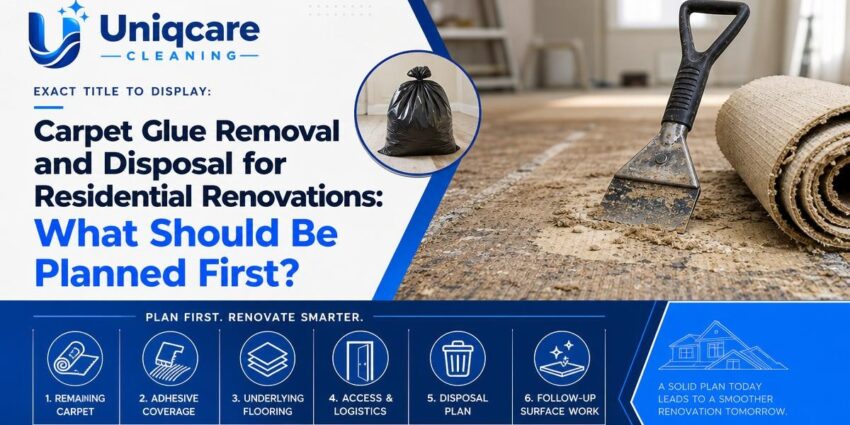
A carpet glue removal service should be planned before renovation work begins, not treated as a last-minute cleanup task. The remaining carpet, adhesive coverage, underlying floor, access route and disposal arrangements can all affect the work sequence and the condition of the surface that remains.
Why carpet glue removal belongs in the renovation plan
Removing an old carpet is only one part of preparing a room for a new finish. Carpet may be fixed with adhesive across the whole floor, in strips, around edges or in scattered patches. Once the carpet is lifted, the adhesive can remain attached to the floor and may need separate attention before another covering or treatment is installed.
Planning early gives the homeowner, tenant, contractor or property manager time to decide what should happen to the exposed floor. The next step could involve installing a new floor covering, carrying out floor cleaning, arranging surface polishing where suitable, or simply leaving the area ready for another renovation trade. The correct sequence depends on the condition and type of the underlying surface.
First, record what is still in the room
Before requesting a quotation or arranging a visit, make a simple inventory of the work area. This prevents important details from being missed when the scope is discussed.
- Identify whether the carpet is wall-to-wall, fitted in sections or used as an area rug.
- Note whether underlay, carpet strips, staples or other fixing materials are still present.
- Check whether furniture, built-in cabinets or appliances cover part of the carpet.
- Estimate the number of rooms and the approximate floor area involved.
- Take photographs of the carpet, visible adhesive and room entrances.
- Record any areas where the floor appears cracked, damp, uneven or already damaged.
Photographs cannot replace an inspection, but they help communicate the starting condition. It is also useful to state whether the room is empty or occupied. Items that cannot be moved may limit access to the carpet and adhesive beneath them, so this should be discussed before the work date.
Check the adhesive coverage before choosing the work sequence
Adhesive is not always spread in the same way. Some installations use broad coverage, while others leave lines, blobs or perimeter adhesive. The amount that remains after carpet removal may therefore vary significantly from one room to another.
| Condition to check | Why it matters | Planning question |
|---|---|---|
| Carpet still attached | The carpet may need to be lifted before the adhesive can be assessed properly. | Will removal and adhesive work be arranged together? |
| Thin adhesive residue | Light residue may still affect the next floor finish. | What surface condition is required after cleaning? |
| Thick or widespread adhesive | More preparation may be needed before the floor can be used or covered. | Should the contractor inspect the area before scheduling? |
| Adhesive at edges and corners | These areas are easy to overlook when the main carpet is removed. | Will skirting edges, thresholds and corners be included? |
| Unknown adhesive condition | The visible surface may not show the full extent of the residue. | Can photographs or an on-site assessment clarify the scope? |
Do not assume that a floor is ready simply because the carpet has been taken up. Adhesive can remain under loose sections or along the perimeter. A clear scope should state whether the requested work covers carpet lifting, adhesive removal, loose debris collection, old carpet disposal, or additional floor treatment.
Identify the underlying flooring
The floor beneath the carpet is one of the most important planning details. It may be concrete, tile, timber, vinyl, laminate, terrazzo, marble or another material. Each surface has its own condition, finish and limitations, and the removal approach should be considered with that surface in mind.
If the flooring is not visible, look for an exposed section beneath a doorway, inside a closet or at a damaged edge. If there is no safe inspection point, tell the service provider that the substrate is unknown. This is better than making assumptions about how much cleaning, scraping or follow-up work will be suitable.
Questions about the exposed floor
- Is the floor intended to remain exposed after the renovation?
- Will another material be installed over it?
- Is the existing floor valuable, decorative or easy to damage?
- Are there cracks, stains, loose tiles, scratches or moisture concerns?
- Does the renovation contractor have requirements for surface smoothness or cleanliness?
A carpet glue removal service can address adhesive on various flooring surfaces, but the final appearance and suitability of the floor may depend on its original condition. Adhesive removal should not be confused with repairing structural damage, replacing flooring or guaranteeing a particular finish.
Decide what should happen to the old carpet
Old carpet disposal needs its own place in the renovation schedule. Rolled carpet can be bulky, difficult to carry through narrow corridors and awkward to store while other trades are working. Underlay, carpet strips and loose debris may also need to be separated from the main carpet material.
Ask in advance whether disposal is included in the requested service or needs to be arranged separately. Disposal requirements can vary according to the property, building management rules and local arrangements. For apartments, condominiums and commercial buildings, confirm the permitted collection point, lift booking requirements and access times with the building manager.
Old carpet disposal checklist
- Confirm which materials will be removed: carpet, underlay, strips, staples and loose adhesive debris.
- Ask whether the service includes carrying the material out of the room.
- Check whether building management has rules for renovation waste.
- Reserve a suitable loading or collection area if the property requires one.
- Keep the disposal plan separate from any assumption about recycling or general waste handling.
- Make sure the room will be clear when the next renovation trade arrives.
Clear disposal planning helps avoid a situation where the adhesive has been removed but rolls of old carpet remain in the property. If a provider offers carpet disposal as part of the service, confirm the exact scope before work starts.
Plan access before the appointment
Access affects both preparation and removal. A ground-floor room with a wide entrance is different from an upper-floor unit reached through a small lift or narrow staircase. The route from the room to the collection point should be considered before furniture and carpet waste begin moving through the property.
Share practical details such as parking restrictions, loading access, lift dimensions, stairs, security desks, renovation-hour limits and the distance to the room. If the work is in an occupied home, decide where furniture will be placed temporarily. A clear route can make the work area easier to inspect and reduce disruption to other renovation activities.
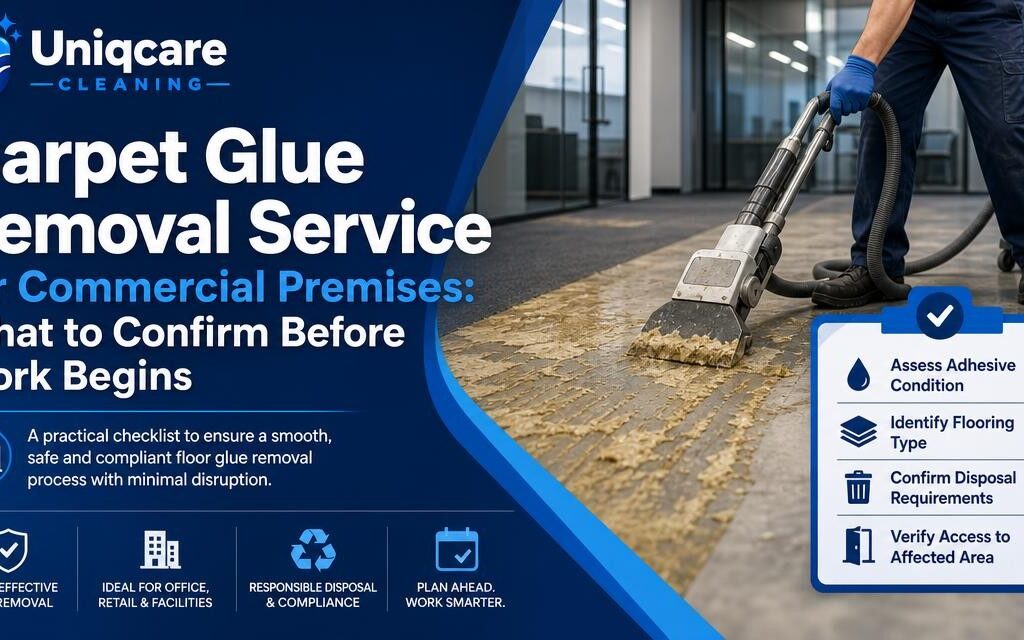
Coordinate carpet removal with other trades
Renovation work is easier to manage when the sequence is agreed in advance. Carpet and adhesive removal commonly need to happen before a new floor finish is installed, but the exact order may depend on electrical, plastering, painting and carpentry work in the same room.
For example, if walls are being painted, the project manager may want dusty removal work completed before final painting. If new flooring is being installed, the installer may need the surface free from carpet residue and loose debris first. If floor polishing or another surface treatment is being considered, the responsible contractor should confirm the required condition of the floor before scheduling it.
A practical renovation sequence
- Confirm the renovation scope and identify the areas where carpet remains.
- Inspect or document the carpet, adhesive and underlying floor.
- Arrange furniture movement and building access.
- Remove the carpet, underlay and associated loose materials.
- Complete carpet adhesive removal and collect the resulting debris.
- Check the exposed floor and discuss any suitable follow-up surface work.
- Allow the next flooring, painting or finishing trade to proceed according to its requirements.
This sequence is a planning framework rather than a guaranteed method for every property. Existing damage, hidden flooring conditions and the requirements of the next trade may change the order.
Ask what follow-up surface work may be needed
After adhesive is removed, the exposed floor may still require attention. Depending on the surface, the renovation plan may include floor cleaning, removal of remaining loose residue or a suitable polishing service. The need for follow-up work should be assessed rather than assumed.
Ask whether the requested scope ends after adhesive removal or includes optional floor surface polishing. The service information for Uniqcare Cleaning describes carpet adhesive removal, carpet disposal and optional floor surface polishing. Any additional treatment should be discussed in relation to the actual floor material and its condition.
| Planning stage | Information to prepare | Outcome to clarify |
|---|---|---|
| Before booking | Room photographs, approximate area and carpet condition | Whether the scope can be assessed from the initial information |
| Before arrival | Furniture plan, access instructions and building rules | How the team will reach and clear the work area |
| During scope confirmation | Floor type, adhesive coverage and edge conditions | What removal and disposal include |
| After removal | Condition of the exposed floor | Whether further cleaning or polishing should be considered |
| Before the next trade | Installer or contractor requirements | Whether the surface is ready for the next planned activity |
What to ask a carpet glue removal service
A useful enquiry gives the provider enough information to understand the job and gives you a clearer idea of what is included. Instead of asking only for a price, describe the property and the renovation deadline, then ask focused questions.
- Does the service cover carpet removal, adhesive removal, or both?
- Is old carpet disposal included, and what materials are covered?
- Can the work be carried out on the identified flooring type?
- Should furniture be moved before the appointment?
- Are corridors, stairs, lifts and loading arrangements relevant to the booking?
- Can optional floor surface polishing be discussed after the adhesive is removed?
- What photographs or measurements are needed before confirming the scope?
These questions are especially useful when the renovation has a fixed handover date. They help separate the removal task from later work that may belong to a flooring installer, renovation contractor or another specialist.
When to contact Uniqcare Cleaning
Uniqcare Cleaning provides carpet glue removal and disposal services for residential and commercial customers. Its listed service includes removal of carpet adhesive from various flooring surfaces, carpet disposal and optional floor surface polishing. The company provides professional deep-cleaning services in Kuala Lumpur, Selangor, Putrajaya and Cyberjaya.
For a renovation enquiry, prepare photographs, the property location, the approximate number of rooms, access details and the condition of the carpet. You can then explain whether you need old carpet disposal, adhesive removal, possible floor polishing or a combination of these tasks. The listed contact telephone number is 019-309 7102, with operating hours stated as Monday to Saturday, 8:30 to 17:00.
Final renovation planning checklist
- Confirm which carpeted rooms are included.
- Record whether carpet, underlay, strips and adhesive remain.
- Identify the underlying floor where possible.
- Photograph the room, edges, doorways and visible adhesive.
- Decide whether the floor will be covered again or left exposed.
- Confirm furniture movement and access arrangements.
- Check building rules for renovation waste and collection.
- Clarify whether old carpet disposal is included.
- Ask about optional floor cleaning or polishing after removal.
- Coordinate the timing with flooring, painting and other renovation trades.
The main planning principle is simple: define the material, the surface, the access route and the next renovation step before the carpet is removed. That preparation makes it easier to request the right carpet glue removal service and reduces uncertainty about what happens to the room afterwards.
Frequently Asked Questions
What does a carpet glue removal service usually address?
It addresses carpet adhesive remaining on the underlying floor after carpet removal. The confirmed scope may also include carpet disposal and optional floor surface polishing, depending on the service arrangement.
Should carpet removal and adhesive removal be booked together?
They can be planned together when the carpet is still attached, but the exact arrangement depends on the property and the provider’s scope. State clearly whether the carpet has already been removed.
Is old carpet disposal automatically included?
Not necessarily. Ask whether disposal covers carpet, underlay, strips and loose debris, and confirm any building or local disposal requirements before the appointment.
Can adhesive be removed from every type of flooring?
The suitable approach depends on the flooring material, its condition and the adhesive. Identify the surface where possible and disclose any cracks, damage or uncertainty before work is scheduled.
Will the floor look new after carpet glue removal?
Not necessarily. The final appearance can be affected by the floor’s age, existing damage, staining and the adhesive condition. Follow-up cleaning or polishing may be considered where suitable.
What information should I send when requesting a quotation?
Send the property location, room count, approximate area, photographs, carpet condition, access details and your disposal needs. Mention whether furniture remains in the room and what renovation work follows.