
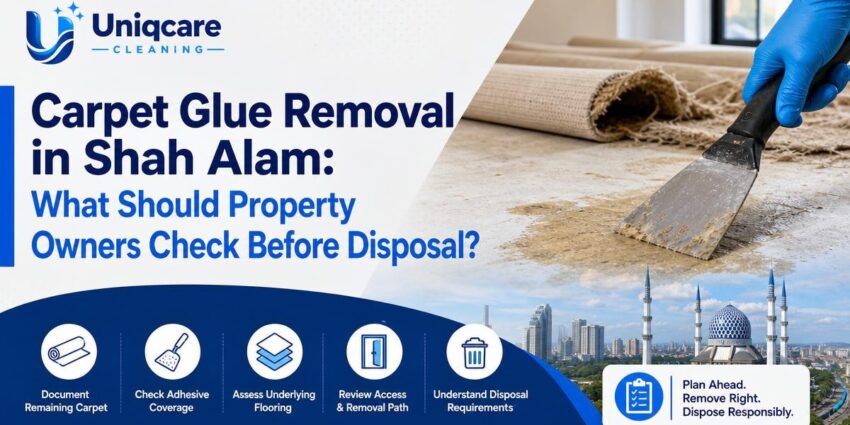
Planning carpet glue removal in Shah Alam involves more than lifting an old carpet and scraping the floor. Before requesting an assessment, property owners should document what remains, identify the underlying flooring, note how widely the adhesive is spread and check the practical conditions for removal and disposal. Clear information helps a service provider understand the job and discuss the most suitable next steps for the property.
Why preparation matters before carpet glue removal
Carpet may be installed over concrete, tiles, timber, vinyl or another finished surface. The adhesive may appear as a few dry patches, a continuous layer, strips around the perimeter or a thick residue beneath the carpet backing. These differences can affect how the work is approached and what condition the floor may be in after the covering and adhesive are removed.
Preparation also separates two related tasks: removing the carpet glue from the floor and dealing with the old carpet itself. A property owner may need both carpet adhesive removal and old carpet disposal, but the amount of material, access route and disposal expectations can vary from one Shah Alam property to another.
What to document before requesting an assessment
A short record with photographs and measurements gives useful context before an on-site discussion. It does not need to be a technical report. The aim is to show the current condition and identify anything that could affect planning.
- Location: Record the property address or general area in Shah Alam and identify the rooms or zones involved.
- Approximate size: Measure the length and width of each affected area where possible.
- Remaining carpet: Note whether the carpet is fully installed, partly lifted or already cut into sections.
- Adhesive coverage: Describe whether glue is visible across the entire floor, in strips, around edges or in isolated patches.
- Floor condition: Record cracks, loose tiles, damaged boards, moisture, discolouration or other visible concerns.
- Access: Note the floor level, lift or stair access, parking arrangements and the distance from the room to the loading point.
- Disposal requirements: Check whether the building management, landlord or site operator has rules for removing bulky waste.
Photographs should include wide views of each room and closer images of the carpet edge, adhesive, skirting boards and exposed floor. If a small section has already been lifted, photograph the transition between the carpeted and exposed areas. This can show whether the adhesive is bonded to the floor, attached to the backing or present in both places.
1. Check how much carpet remains
The first practical question is whether the old carpet is still in place. A fully installed carpet may need to be separated into manageable sections before removal. A partially removed carpet may leave loose backing, tack strips, underlay or adhesive exposed. These materials should be identified rather than mixed together in the description of the job.
Look for carpet in less obvious areas, including beneath cabinets, along room edges, inside corridors and under fixed furniture that can be moved safely. If furniture or fittings cannot be moved, record that limitation. Do not dismantle built-in items simply to prepare photographs unless the property owner or manager has authorised it.
Questions to record about the carpet
| Item to check | What to record |
|---|---|
| Coverage | Full room, partial room, corridor, staircase or isolated section |
| Carpet condition | Intact, torn, damp, heavily soiled, brittle or already cut |
| Backing and underlay | Whether separate layers remain attached to the floor |
| Edges | Presence of tack strips, glued borders or loose perimeter sections |
| Furniture | Items that remain in place and may limit access |
This information is particularly useful when the property is being renovated, handed back to a landlord or prepared for a new floor finish. It helps distinguish removal of a floor covering from cleaning or preparation of the surface underneath.
2. Identify the underlying flooring
Carpet glue removal should be planned with the underlying floor in mind. Concrete, ceramic tile, vinyl, timber, laminate and other surfaces may respond differently to scraping, agitation or cleaning. If you are unsure what lies beneath the carpet, record what can be seen at an exposed edge instead of guessing.
Check whether the floor is intended to remain visible after the work. In some cases, the next step may be a new floor covering. In others, the owner may want the surface cleaned or considered for floor surface polishing where suitable. The desired final use matters because removing adhesive is not the same as restoring every mark or imperfection in the substrate.
Important flooring observations
- Is the exposed surface concrete, tile, wood, vinyl or an unknown material?
- Are there loose tiles, lifted boards, cracks or gaps?
- Does the surface show water damage, dampness or staining?
- Is the adhesive soft, tacky, rubbery, powdery or hard and brittle?
- Are there existing scratches or marks that should be documented before work begins?
Existing damage should be photographed before removal. This creates a clear record of the starting condition and gives the assessment a more accurate basis. Adhesive removal may reveal differences in colour or wear between areas that were covered and areas that were exposed, so the finished appearance may depend on the original floor as well as the glue.
3. Describe the adhesive and how widely it is spread
Not all carpet adhesive is left in the same pattern. Some installations use lines, dots or perimeter bonding, while others leave a broad film across the floor. The visible appearance can change with age, previous cleaning, heat, moisture and the carpet backing itself.
Do not try to identify the exact adhesive type from colour alone. Instead, describe what is visible and whether a small area has already been tested. Avoid applying solvents, strong chemicals or improvised heat before an assessment, especially when the flooring material is unknown. An unsuitable product may spread residue, damage the finish or create additional cleaning work.
Photographing adhesive coverage
Take one photograph that shows the overall pattern and several close-ups that show thickness and texture. Include a familiar object for scale if appropriate, but do not place objects into the adhesive. Note whether residue is concentrated at seams, doorways, corners or high-traffic areas.
If the building is commercial, also record whether the affected area connects to an office, retail space, classroom, corridor or shared passage. The work area may need to be planned around employees, visitors, tenants or other occupants.
4. Check access and site conditions in Shah Alam
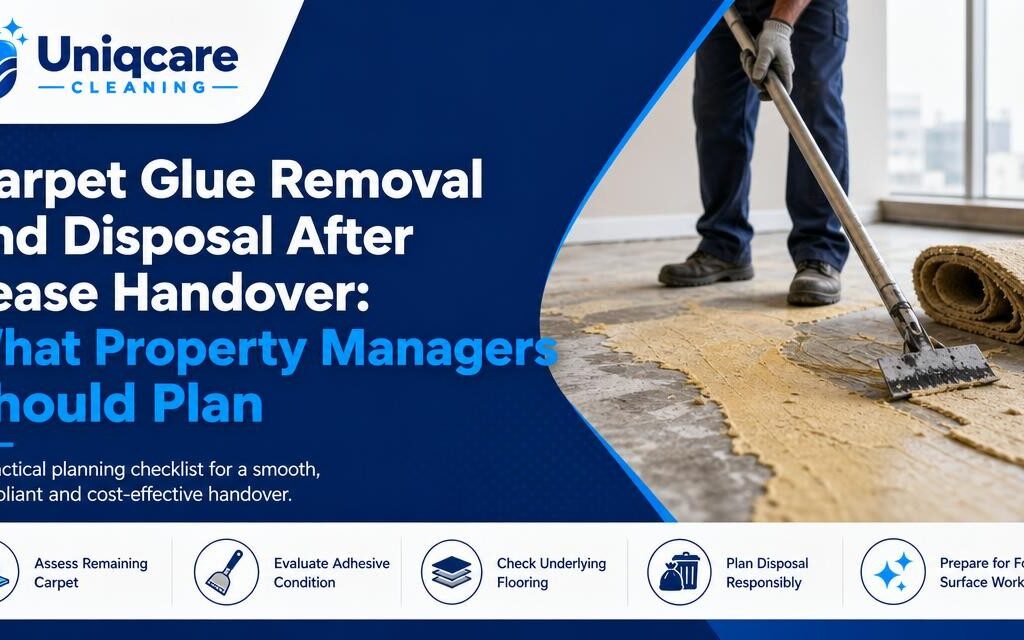
Access can influence how carpet and waste are moved through a property. A ground-floor terrace, high-rise unit, office suite and shop lot may each have different practical requirements. Record whether there is a lift, a staircase, a loading bay, restricted parking or a long route from the affected room to the exit.
For apartments, offices and managed commercial premises, ask about building rules before arranging removal. Management may require advance notice, protection for common areas, a service lift booking or removal during specified hours. These requirements are separate from the physical carpet glue removal itself, but they can affect scheduling and handling.
- Confirm the building’s rules for contractors and bulky waste.
- Identify the nearest practical entrance and loading point.
- Clear loose items from the work area where safe to do so.
- Tell the assessor about stairs, narrow doorways and restricted corridors.
- Keep children, pets, staff and visitors away from the active work zone.
If the property is occupied, consider how the area will be separated from normal activity. A clear route and an accessible work zone can make the assessment more productive and reduce the need to move items repeatedly.
5. Separate removal from old carpet disposal
Old carpet disposal should be discussed as its own requirement. A property owner may have rolled carpet, underlay, backing, tack strips and loose adhesive residue. The volume and condition of these materials can affect how they are gathered and taken away.
Before arranging disposal, check whether the property has a designated waste area or whether building management has a preferred collection process. Do not leave carpet, adhesive containers or torn backing in a shared corridor or unauthorised bin area. If a waste service is being considered, confirm what materials it accepts and whether the removal scope includes the carpet, underlay and related debris.
| Material or issue | Why it should be mentioned |
|---|---|
| Rolled carpet | Shows the approximate amount of bulky material requiring handling |
| Underlay or backing | May be separate from the carpet and may leave additional residue |
| Tack strips or fasteners | Can create handling and safety concerns if left attached |
| Adhesive residue | Needs to be treated as part of floor preparation rather than ordinary rubbish |
| Building disposal rules | May determine where and when removed materials can be taken |
Uniqcare Cleaning lists carpet disposal together with carpet glue removal services. When making an enquiry, explain whether you need only adhesive removal, removal of the remaining carpet, or both. The provider can then understand the requested scope more clearly.
6. Consider the intended use of the floor after removal
The expected next step affects what information should be gathered. If a new carpet will be installed, the priority may be removing loose material and preparing the area for the next installer. If the floor will remain exposed, the owner may also want to discuss its condition, visible marks and whether a suitable floor cleaning or polishing option should be considered.
Do not assume that removing glue will make an old floor look new. The final appearance can be influenced by wear, sunlight, moisture, previous repairs and areas that were not covered by carpet. A clear conversation about the intended finish helps avoid confusing adhesive removal with full floor restoration.
Before-and-after expectations
- Document the original floor before any carpet or adhesive is disturbed.
- Explain whether the surface will be covered again or left visible.
- Point out marks that existed before the work.
- Ask which parts of the requested work concern removal and which concern cleaning or polishing.
- Allow the condition of the substrate to guide final recommendations.
What to include in a carpet glue removal enquiry
A useful enquiry can be brief but specific. Include the Shah Alam location, property type, affected rooms, approximate dimensions, photographs, the amount of carpet remaining and the type of access available. State whether the carpet has already been lifted and whether old carpet disposal is required.
You can also mention the preferred timing, building restrictions and intended floor finish. If the property is commercial, identify the operating hours or periods when the space is available for assessment. Uniqcare Cleaning provides professional deep-cleaning services for residential and commercial clients and serves Selangor, along with Kuala Lumpur, Putrajaya and Cyberjaya. The company lists carpet glue removal and disposal among its services.
A practical checklist for Shah Alam property owners
- Photograph every affected room before moving the carpet.
- Measure the approximate carpeted area.
- Record whether carpet, underlay, backing and edge materials remain.
- Identify the visible underlying flooring without guessing its composition.
- Photograph adhesive texture, thickness and coverage.
- List existing cracks, stains, dampness, loose tiles or damaged boards.
- Check access, parking, lifts, stairs and loading points.
- Ask building management about contractor access and bulky waste.
- Confirm whether the request includes old carpet disposal.
- Explain whether the floor will be covered again or left exposed.
- Keep people and pets away from the area while it is being assessed or worked on.
When to request an assessment
Request an assessment when the scope is unclear, adhesive covers a large area, the underlying floor is valuable or the property has access and disposal restrictions. An assessment is also sensible when carpet has been removed unevenly, residue is bonded firmly or the floor shows signs of damage or moisture.
For Shah Alam homes, offices and commercial spaces, sending organised photographs and details can make the initial discussion more useful. It allows the requested carpet glue removal work to be considered alongside carpet disposal, floor condition, access and the intended use of the space.
Frequently asked questions
What does carpet glue removal involve?
It involves addressing adhesive residue left on the underlying floor after carpet is removed. The suitable approach depends on the adhesive coverage, floor material, residue condition and existing surface damage.
Should I remove the old carpet before requesting an assessment?
Not necessarily. You can request an assessment with the carpet still in place or partly removed. Photograph the current condition and explain what has already been lifted.
Is old carpet disposal included in carpet glue removal?
It may be requested as part of the overall scope, but it should be stated clearly. Tell the provider whether you need removal of carpet, underlay, backing and related materials as well as adhesive removal.
What photographs are useful for a carpet glue removal enquiry?
Useful photographs include wide views of each affected room, close-ups of the carpet edge and adhesive, exposed flooring, damaged areas, access routes and any storage or disposal constraints.
Can every type of floor be treated in the same way?
No. Concrete, tile, timber, vinyl and other surfaces can have different sensitivities and conditions. Identify the visible flooring and allow the assessment to guide the planned work.
Should I apply a solvent before professional carpet adhesive removal?
It is better not to apply an unconfirmed chemical or heat treatment to an unknown floor. An unsuitable product may damage the surface or spread the residue.
What should Shah Alam property owners tell Uniqcare Cleaning?
Share the property location, affected area, carpet and adhesive condition, photographs, access details, building rules, disposal needs and intended use of the floor after removal.