
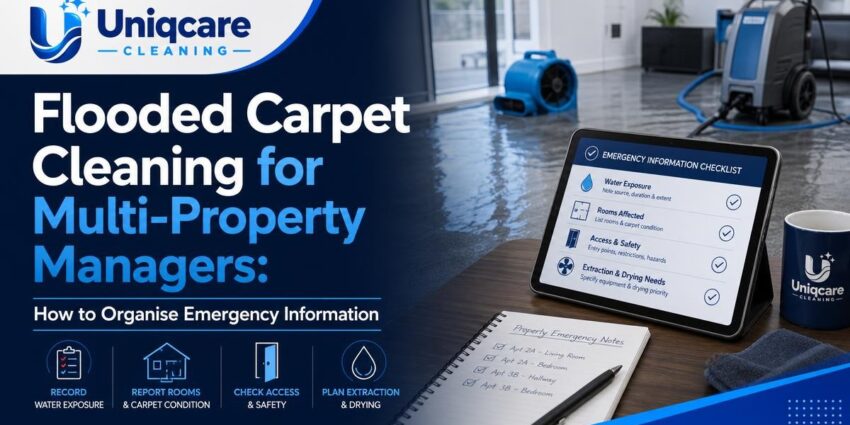
When several properties experience water intrusion, arranging flooded carpet cleaning is only one part of the emergency response. Property managers also need to gather accurate information, separate urgent issues from routine follow-up, coordinate access and explain the condition of each affected carpet clearly. A consistent reporting system helps a cleaning provider understand what is required before arriving and helps the management team keep every property’s information in one place.
Why organised information matters after carpet flooding
Flood damage rarely affects every room in the same way. One unit may have water across a small bedroom, while another property may have wet wall-to-wall carpet in corridors, offices or shared areas. The water may have entered at different times, and some carpets may still be wet while others have already developed a damp smell or visible soiling.
When information is collected informally through separate phone calls and messages, important details can be missed. A technician may not know which rooms are affected, whether access requires security approval, or whether furniture needs to be moved before extraction. A property-by-property record creates a clearer starting point for discussing extraction, carpet cleaning, drying and any additional restoration requirements.
Create one emergency record for every property
Use the same form or spreadsheet structure for every affected address. The purpose is not to produce a technical assessment before the cleaning team arrives. It is to record observable facts in a consistent way so that the service request is accurate and easy to prioritise.
| Information to record | What to include | Why it helps |
|---|---|---|
| Property identification | Building, unit, floor, room or shared-area name | Prevents reports from being confused across multiple locations |
| Water exposure | Suspected source, affected area and when the issue was noticed | Provides context for the condition of the carpet |
| Carpet condition | Wet, saturated, damp, stained, soiled or odorous | Helps describe the cleaning and drying requirements |
| Access details | Contact person, security procedure, parking or entry restrictions | Reduces delays when the team attends the property |
| Site concerns | Standing water, unsafe access, electrical concerns or blocked rooms | Alerts everyone to conditions that require attention before work begins |
| Evidence | Photographs, videos and notes linked to the correct property | Supports clearer communication and internal follow-up |
Record the water exposure carefully
Start with what is known rather than guessing the cause. Note whether the water came from heavy rain, a plumbing incident, an overflowing fixture, a leak or another observed source. If the source is unknown, record it as unknown. Also write down when the water was first noticed and whether the area is still being affected.
Record the approximate spread of the water. Useful descriptions include “bedroom carpet near the window,” “corridor from the lift lobby to the office entrance” or “entire carpeted room.” If multiple rooms are involved, list them separately. A room-by-room description is more useful than simply writing “carpet flooded,” especially when a manager is coordinating several properties at once.
Use photographs that explain the situation
Photographs can show the carpet, skirting, furniture placement and surrounding flooring. Take wide images to identify the room and closer images to show staining, standing water or visible soiling. Keep the original files where possible and label them with the property, room and date. Avoid sending a large group of unlabelled images that may be difficult to match to the correct report.
Describe carpet condition without making assumptions
Property managers do not need to diagnose the carpet. Simple observations are enough. Indicate whether the carpet feels wet, appears damp, has visible marks, has been exposed to dirty water or has developed an odour. If you do not know how deeply the water has travelled into the carpet or underlay, say so rather than estimating.
The carpet’s construction and condition may affect the options available. Note whether it appears to be an area rug, a fitted wall-to-wall carpet, carpet tiles or another type. Also record whether it is loose, lifting, buckling or attached to the floor. These details help the provider discuss a suitable approach after reviewing the site.
- Wet or saturated: water is still present or the carpet is visibly holding water.
- Damp: the surface is not visibly flooded but remains wet to the touch or has not dried.
- Stained or soiled: marks or dirt are visible after the water event.
- Odour present: a damp or unpleasant smell has developed.
- Unknown: the room has not yet been inspected closely.
Separate extraction, cleaning and drying requirements
These terms describe related but different needs. Water extraction concerns removing standing or absorbed water. Carpet cleaning addresses dirt, residues and the condition of the carpet surface. Drying focuses on reducing remaining moisture after extraction and cleaning. A request for “cleaning only” may not communicate the full situation if the carpet is still saturated.
Uniqcare Cleaning’s flooded carpet cleaning service is described as including industrial water extraction, carpet cleaning and restoration, and drying. Optional sanitisation is also listed. The actual requirements should still be discussed for each property because the material, exposure and condition may differ from one room to another. Do not assume that every affected carpet requires the same treatment.
| Observed situation | Information to send | Service discussion to request |
|---|---|---|
| Standing water remains | Depth if known, affected rooms and whether the source is controlled | Urgent extraction and site assessment |
| Carpet is wet but no standing water is visible | Approximate affected area and time first noticed | Extraction and drying requirements |
| Carpet has dried partly | What was done, when it was done and current odour or staining | Cleaning, restoration and further drying options |
| Water was visibly dirty | Source description and materials contacted by the water | Cleaning and optional sanitisation discussion |
Build a priority list across multiple properties
A multi-property response becomes easier when every location is assigned a clear status. The status should reflect the information available, not a promise about the final result. For example, a property with active water entry and saturated carpet may need to be reviewed before a property where the carpet is only slightly damp.
Suggested emergency status categories
- Immediate attention: water is still entering, standing water is present or the affected area is blocking essential access.
- Urgent assessment: the source has stopped, but carpet remains wet, saturated or heavily affected.
- Follow-up cleaning: the carpet has dried partly or the immediate extraction has already taken place, but cleaning or restoration is still needed.
- Inspection required: the extent of the damage or condition has not yet been confirmed.
- Completed for review: work has taken place and the manager is checking the result or arranging next steps.
Keep the priority reason beside the status. “Urgent” on its own is less useful than “urgent because corridor carpet remains wet and the area is needed for building access.” This wording helps the cleaning provider and the internal team understand why a property has been placed ahead of another.

Confirm access before contacting flooded carpet cleaning services
Access problems can delay work even when the cleaning request is clear. Record the name and phone number of the person who can open the property, the permitted access hours, lift or loading instructions and any security registration process. For managed buildings, note whether the cleaning team needs approval from the building office or security desk.
Also identify obstacles inside the affected area. Furniture, stored items, office equipment and closed rooms may affect the work plan. Do not promise that items will be removed or that every room can be treated without preparation. Instead, record what is present and ask the provider what needs to be moved before attendance.
Include safety and site-condition notes
Water and electricity can create serious risks. Managers should follow their own emergency procedures and the instructions of the relevant building, utility or emergency personnel. Do not enter an unsafe area simply to collect photographs or measurements. If the floor is slippery, the ceiling is damaged, power may be affected or access is blocked, record the concern and communicate it before arranging work.
Keep the cleaning request focused on carpet information while separately escalating building damage that requires another contractor or authority. Flooded carpet cleaning can address the carpet-related requirements, but it should not be presented as a substitute for plumbing, electrical, structural or building repairs.
Prepare a concise service request
Once each property has been recorded, combine the essential information into a short message or call script. A provider should be able to understand the scale of the request without searching through unrelated conversations.
Property: [building and unit]
Location: [city or area]
Affected rooms: [list rooms]
Water noticed: [date and approximate time]
Source: [known, suspected or unknown]
Condition: [wet, saturated, damp, stained or odorous]
Access: [contact, entry instructions and restrictions]
Photos available: [yes or no]
Requested discussion: [extraction, carpet cleaning, drying, restoration or optional sanitisation]
For a large portfolio, send a summary table first and keep detailed photographs and room notes available. Ask whether the provider can review several properties as one coordinated request. Uniqcare Cleaning provides flooded carpet cleaning for homes and businesses across Kuala Lumpur, Selangor, Putrajaya, Cyberjaya and the Klang Valley, subject to confirming the details of the request.
What to ask when arranging the service
Clear questions help managers avoid misunderstandings. Ask which information is needed before attendance, whether a site assessment is required, what preparation should be completed and whether extraction, carpet cleaning and drying will be considered separately. If several properties are involved, confirm how the locations should be listed and who should receive updates.
- Can the team review the property and affected rooms before recommending the work?
- What access, parking or building approvals are needed?
- Should furniture or other items be moved before attendance?
- Does the request require extraction, cleaning, drying or a combination?
- Should optional sanitisation be discussed because of the type of water exposure?
- What site information should be recorded after the work is completed?
Keep the answers with the original property record. This creates a useful handover between the manager, building representative, tenant and cleaning provider. It also makes it easier to identify which rooms still need attention after the first visit.
Keep a post-service record
Emergency coordination does not end when the carpet has been cleaned. Record the date of attendance, rooms addressed, work discussed or completed, remaining concerns and any recommended follow-up. Add updated photographs only when they are clearly labelled and compared with the original condition.
Use careful wording in internal reports. You can record that extraction or cleaning was completed, but avoid promising that every stain, odour or sign of damage will disappear. Results can depend on the carpet material, the type of water, how long the carpet was exposed and its condition before the incident.
How Uniqcare Cleaning can support a coordinated request
Uniqcare Cleaning provides professional deep-cleaning services for residential and commercial clients, including carpet cleaning and flooded carpet cleaning. The flooded carpet service is described as offering emergency support, industrial water extraction, carpet cleaning and restoration, drying and optional sanitisation. Managers can prepare the property information first and then contact the company to discuss the affected locations and requirements.
The company serves Kuala Lumpur, Selangor, Putrajaya and Cyberjaya. The listed telephone number is 019-309 7102, and the stated operating hours are Monday to Saturday, 8:30 to 17:00; the flooded carpet service description also refers to 24/7 emergency availability. Confirm current availability, access arrangements and the scope of work when contacting the team.
FAQ about flooded carpet cleaning for property managers
What information should a manager provide first?
Provide the property address or building reference, affected rooms, suspected water source, time the issue was noticed, current carpet condition, access details and any safety concerns. Photographs can add useful context when labelled correctly.
Should every affected property receive the same carpet treatment?
Not necessarily. Water exposure, carpet material, room use, condition and drying needs can differ. Record each property separately and ask the cleaning provider to discuss the appropriate requirements.
Is flooded carpet cleaning the same as ordinary carpet cleaning?
No. Flood-related work may involve water extraction and drying as well as carpet cleaning and restoration. Tell the provider whether the carpet is still wet or saturated rather than requesting routine cleaning alone.
What should managers do if the water source is still active?
Follow the property’s emergency procedures and arrange for the source to be controlled by the appropriate person or contractor. Record that the source is active and communicate it before carpet work is planned.
Can a provider guarantee that a flooded carpet will be saved?
No result should be assumed in advance. Salvage and cleaning outcomes may depend on the carpet, water exposure, material, condition and time before treatment. A provider can discuss the situation after reviewing the available information.
Does Uniqcare Cleaning serve commercial properties across several areas?
Uniqcare Cleaning provides services for homes, offices and commercial spaces and lists Kuala Lumpur, Selangor, Putrajaya and Cyberjaya as service regions. Managers should confirm availability and arrangements for each affected property.