
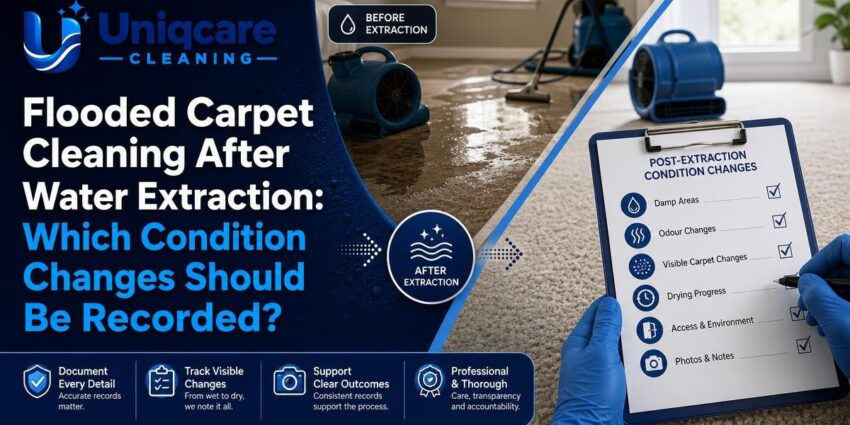
After water extraction, flooded carpet cleaning is not finished simply because standing water is no longer visible. A clear record of the carpet’s condition helps homeowners, tenants, offices and commercial premises track drying progress, describe changes accurately and decide what follow-up attention may be needed. The most useful notes cover damp areas, odour, visible carpet changes, drying conditions and access to the affected space.
Why documentation matters after carpet flooding
Water can move below the carpet surface and into the backing, underlay or flooring beneath it. As a result, a carpet may look much better after extraction while some areas remain damp. Recording the condition at different stages creates a practical reference point instead of relying on memory.
Documentation is also useful when several people are involved, such as a tenant, property owner, facilities manager, cleaner or building representative. Everyone can refer to the same observations, including where the water reached, which areas were treated and whether the carpet’s appearance or smell changed as drying continued.
Record observations, not assumptions
A good record describes what can be seen, felt or smelled at the time of inspection. Avoid turning an observation into a definite conclusion. For example, “musty odour noticed near the window-side edge” is more useful and precise than “mould has formed.” A professional assessment may be needed before identifying the cause of a change.
The same principle applies to salvage or restoration. Notes can show the carpet’s condition before and after extraction, but they should not promise that a carpet will be fully restored or suitable for continued use. Material, construction, contamination, exposure time and the condition of the backing can all affect the outcome.
The main condition changes to record
Post-extraction notes should be consistent enough to compare one inspection with the next. Use the same room reference points where possible, such as the doorway, wall, furniture line or affected edge. Photographs taken from similar positions can make changes easier to review.
| Condition to record | What to note | Why it is useful |
|---|---|---|
| Dampness | Location, size of affected area and whether moisture seems concentrated at an edge, seam or low point | Shows whether drying is progressing evenly or whether a particular section remains affected |
| Odour | Presence, strength, location and whether the smell changes as the carpet dries | Helps identify areas that may need closer inspection or further cleaning attention |
| Visible changes | Discolouration, tide marks, lifted edges, rippling, flattening or changes in texture | Creates a record of the carpet’s appearance after the incident |
| Drying progress | Which sections feel drier, which remain cool or damp and when each observation was made | Provides a simple timeline for follow-up checks |
| Access and surroundings | Furniture, closed rooms, blocked edges, stored items or other obstacles | Explains why some areas may not have been reached or dried at the same rate |
1. Damp areas and moisture distribution
Start by marking every area that still appears damp after water extraction. Do not record only the visibly wet centre. Check around carpet edges, joins, corners, doorways and places where furniture may have restricted airflow. Moisture can also be more noticeable where the carpet meets a wall or where the floor is lower.
Describe the location in a way another person can understand. “Damp patch beside the sofa, extending from the left wall towards the doorway” is more useful than “living room still wet.” If the affected area is irregular, divide it into smaller sections and label them. A simple room sketch can help when the room is large or several areas are involved.
What a dampness note can include
- The room and exact position of the affected section.
- Whether the carpet surface looks wet, feels cool or remains noticeably damp to the touch.
- Whether dampness is concentrated along an edge, seam, corner or under furniture.
- Whether the affected area appears smaller, unchanged or larger than during the previous check.
- The date and approximate time of the observation.
- Any items that prevented access to the carpet or limited airflow.
Try to use the same checking method each time. Changing the location or method can make two observations difficult to compare. If professional equipment is used, record the readings and the areas where they were taken rather than presenting one reading as representative of the entire carpet.
2. Odour and how it changes
Odour should be recorded separately from visible cleanliness. A carpet may look clean while a damp or musty smell remains, particularly in areas with slower airflow. Conversely, a smell may come from surrounding materials, underlay, furniture or water-affected items rather than only from the carpet surface.
Describe the odour in neutral terms. Useful wording may include “no noticeable odour,” “slight damp smell near the room entrance,” or “musty smell remains beneath the table area.” Note whether it is present throughout the room or limited to one section. Also record whether the odour becomes less noticeable, remains unchanged or is stronger during a later inspection.
Do not treat odour notes as a diagnosis
An odour record shows what was noticed; it does not identify the source by itself. Avoid describing a smell as proof of mould, bacteria or another specific condition without appropriate assessment. If a persistent odour is accompanied by visible changes or continuing dampness, the affected materials may require closer inspection and further cleaning or drying advice.
3. Visible changes in carpet appearance
Water exposure and extraction can change how a carpet looks temporarily or permanently. Record changes without assuming what caused them. Useful observations include darker or lighter patches, tide marks, flattened pile, altered texture, rippling, lifted edges, fraying, separated seams and staining that becomes more noticeable as the carpet dries.
Photographs are most helpful when they show the whole room as well as close-ups of individual areas. Include a stable reference point, such as a doorway or furniture edge, and use similar lighting when taking follow-up images. A written description should accompany each photograph because images may not show dampness, texture or odour accurately.
Appearance checklist
- Overall colour compared with an unaffected section, if one is available.
- Visible water lines or boundaries around the affected area.
- Changes in pile direction, flattening or matting.
- Ripples, buckling, lifted corners or movement at seams.
- New or changed spots, marks or discolouration.
- Damage or changes to skirting boards, furniture feet or nearby flooring.
Do not scrub aggressively or apply unverified chemicals while trying to improve the appearance. Additional moisture, friction or unsuitable products may change the carpet further. Record the condition first and ask for material-appropriate cleaning advice when needed.

4. Drying progress over time
Drying progress should be recorded as a timeline rather than a single statement such as “dry.” Different sections may dry at different rates, especially where furniture, walls, underlay or limited ventilation affect airflow. A follow-up note should identify which areas have improved and which areas still need attention.
Record the conditions that may affect drying, including whether doors or windows were open, whether airflow was available and whether furniture was moved. These details provide context without implying that a particular drying time is guaranteed. The appropriate drying approach depends on the amount and type of water, the carpet system, the surrounding materials and site conditions.
| Check | Example of a useful record |
|---|---|
| Initial condition | “Dampness visible across the area between the hallway and sofa; odour noticed near the wall.” |
| After extraction | “Standing water no longer visible; carpet remains damp along the wall-side edge.” |
| Follow-up observation | “Centre area feels drier; corner behind the cabinet remains cool and damp.” |
| Later check | “No visible wetness in accessible sections; slight odour still noticed near the seam.” |
Keep the wording specific and avoid unsupported certainty. “No visible dampness in the accessible surface” is more accurate than “the entire carpet is dry” when parts of the carpet, backing or underlay could not be checked.
5. Access conditions and areas that could not be checked
Access is an important part of the record because it affects what can be inspected, extracted or dried. Note heavy furniture, built-in units, stored boxes, closed rooms, floor coverings, equipment or other obstacles. If an edge is hidden beneath furniture, record that limitation instead of assuming the area has the same condition as the accessible carpet.
For offices and commercial premises, access may change during business hours. Record whether treatment was possible across the full affected area or only in selected sections. A room plan, labelled photographs and a short list of inaccessible locations can help the property representative arrange the next step.
Useful access details
- Which rooms or carpet sections were available for inspection.
- Which areas were blocked by furniture or stored belongings.
- Whether furniture was moved, lifted or left in place.
- Whether doors, corridors or stairways restricted equipment movement.
- Whether electrical, building or occupant-safety restrictions limited access.
- Whether an inspection is still needed after the area becomes accessible.
How to create a practical post-extraction record
A useful record does not need complicated language. Begin with the date, property or room reference and a short description of the water incident if known. Then list the condition before extraction, the work carried out if confirmed, and the observations made afterward. Keep factual notes separate from questions or recommendations.
- Identify the area. Name the room and use a simple position reference such as “north wall,” “doorway side” or “behind the desk.”
- Record the visible condition. Note dampness, marks, rippling, odour and any changes to nearby materials.
- Document water extraction. Record that extraction took place when confirmed, without assuming that every hidden layer was reached.
- Take consistent photographs. Use wide and close views, with similar angles for later comparisons.
- Note access limitations. List furniture, closed sections or other areas that could not be checked.
- Repeat the inspection. Compare the same sections and record whether each condition improved, remained or changed.
- Flag unresolved issues. Identify persistent dampness, odour or visible changes for further assessment.
When professional flooded carpet cleaning may be appropriate
Professional flooded carpet cleaning can be useful when carpet flooding has affected a large area, when water has reached the backing or underlay, or when the site requires commercial extraction and drying equipment. It can also help create a clearer account of the affected areas and the condition observed during service.
Uniqcare Cleaning lists flooded carpet cleaning and water-damage restoration among its services, including industrial water extraction, carpet cleaning and restoration, drying and optional sanitisation. The business serves homes and businesses in Kuala Lumpur, Selangor, Putrajaya, Cyberjaya and the Klang Valley. The exact work required should be discussed according to the carpet, water exposure, access and condition found at the site.
When contacting a cleaning provider, share the information already recorded: when the flooding occurred, the type or suspected source of water if known, rooms affected, whether extraction has taken place, current odour, visible changes and access restrictions. Clear information can help the provider understand the situation before arranging an assessment or service.
Common documentation mistakes to avoid
- Recording only the centre of the wet area: edges, seams and hidden sections may have a different condition.
- Using vague descriptions: “bad smell” or “damaged carpet” does not explain where or how the condition changed.
- Mixing observation with diagnosis: a musty smell is an observation, not by itself proof of mould.
- Ignoring access limitations: inaccessible areas should be identified clearly rather than treated as checked.
- Taking only one photograph: a single image may not show the room layout or the full affected area.
- Promising a result: documentation should describe conditions without guaranteeing salvage, odour removal or restoration.
- Failing to record timing: without dates or times, it is difficult to understand drying progress.
Final checklist for a clear record
Before closing the file, check that the record answers five basic questions: Where was the carpet affected? What did it look, feel and smell like? What changed after water extraction? Which sections remain uncertain or inaccessible? What should be reviewed again?
Keep photographs, notes, service details and follow-up observations together. A careful record supports better communication between occupants, property representatives and cleaning professionals. It also keeps the focus on the actual condition of the carpet rather than assumptions about what the final outcome will be.
Frequently asked questions
Why should carpet condition be recorded after water extraction?
Recording the condition creates a comparison point for later inspections. It helps show where dampness, odour or visible changes remain and clarifies which sections were accessible.
What damp areas should be included in a flooded carpet cleaning record?
Include visible damp patches, carpet edges, seams, corners, doorways, low points and sections beneath or beside furniture. Describe each location rather than recording only the largest wet area.
How should odour be documented after carpet flooding?
Note whether an odour is present, where it is strongest and whether it becomes weaker, stronger or unchanged during follow-up checks. Describe the smell without treating it as a diagnosis.
Should photographs be taken after flooded carpet cleaning?
Yes. Wide photographs show the room and affected area, while close photographs show marks, rippling or other details. Similar angles and lighting make later comparisons more useful.
What if furniture prevents access to part of the carpet?
Record the exact blocked section, the item causing the restriction and whether the area was moved or left in place. Do not describe an inaccessible section as fully inspected.
Does water extraction prove that the whole carpet is dry?
No. Extraction removes accessible water, but different carpet sections and underlying materials may dry at different rates. Record the condition of each accessible area and arrange follow-up attention when needed.
Can documentation guarantee that a flooded carpet can be saved?
No. A record supports assessment and communication, but it cannot guarantee salvage or restoration. The outcome depends on factors such as material, water exposure, backing, underlay and the condition found after flooding.