
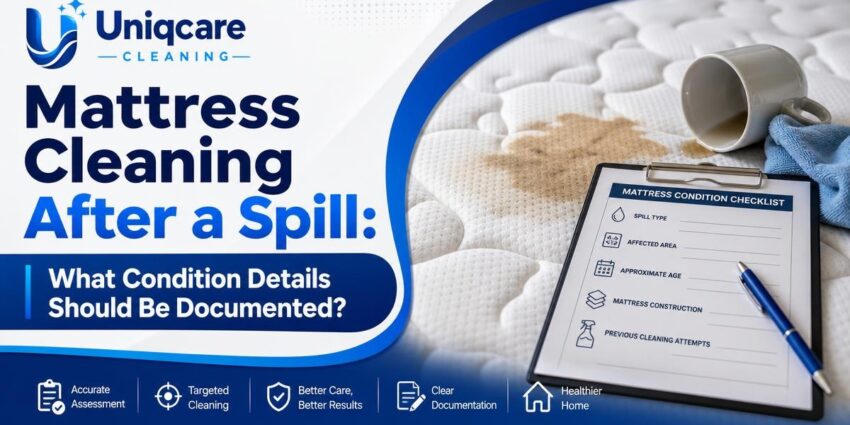
After a drink, food, urine or other liquid spills on a mattress, the information you provide can help a cleaning professional understand the condition before an assessment. Useful details include what caused the spill, how much of the mattress was affected, when it happened, the mattress construction and anything already used during cleaning. Good documentation does not guarantee a particular result, but it gives the cleaner a clearer starting point for mattress stain removal.
Why condition details matter after a mattress spill
A mattress is not simply a flat fabric surface. Its cover, padding, foam, springs and other internal materials may respond differently to moisture and cleaning products. A recent surface spill may present a different challenge from an older mark that has dried, spread or been treated several times.
Accurate information also helps avoid unnecessary assumptions. A dark mark may be caused by a coloured drink, food, bodily fluid, transferred dye or a previous cleaning product. If the cause is unknown, say so. It is better to record uncertainty than to provide an incorrect description that could affect the assessment.
1. Record the type of spill
Start with the substance involved. Describe it as specifically as you can, rather than writing only “liquid” or “stain.” For example, you might record coffee with milk, fruit juice, cooking oil, soup, soft drink or plain water. If the spill involved solid food, note whether crumbs, sauce or grease were also present.
The spill type can provide useful context about colour, residue and odour. A drink containing colour may leave a visible mark, while a greasy substance may create a different surface appearance. If the spill involved urine, vomit, blood or another bodily fluid, state this privately and clearly when requesting an assessment. This information is relevant to selecting an appropriate cleaning approach.
| Detail to document | What to record | Example |
|---|---|---|
| Spill substance | Known liquid or material | Coffee with milk |
| Amount | Approximate quantity or description | One cup, partly absorbed |
| Location | Position on the mattress | Left side near the foot |
| Timing | When the spill occurred | Earlier today or about two weeks ago |
| Cleaning history | Products and methods already used | Blotted with water and applied detergent |
2. Describe the size and exact position
Record where the spill occurred and estimate the affected area. Use familiar references such as the left or right side, near the head or foot, close to the edge, or around the centre. If the mattress has been rotated since the incident, describe the position based on its current orientation and mention that it was turned.
Measure the visible mark if practical. An approximate length and width are more useful than a vague description such as “large.” Also note whether the affected area is one continuous patch, several separate marks or a spreading ring. Include any visible moisture beyond the obvious discolouration, because liquid may travel into surrounding padding.
- Estimate the length and width of each visible mark.
- Note whether the stain is on the top, side, edge or underneath.
- Check whether nearby fabric feels damp, stiff, sticky or rough.
- Record whether the mark has changed size or colour since the spill.
- Take clear photographs in normal lighting, including one wider image for context.
3. Note when the spill happened
Timing is an important part of the condition record. Write down the date and approximate time if the spill was recent. If you do not know the exact date, use a practical estimate such as “three to four days ago” or “sometime last month.” Avoid guessing with false precision.
Explain what happened between the spill and the assessment. For example, you may have left the mattress to air, covered it with bedding, moved it to another room or slept on it before noticing the mark. If the stain was already present when you moved into a rental property, say that as well and record when you first noticed it.
Fresh spill, dried stain or recurring mark?
Indicate whether the area is still wet, partly damp, fully dry or only visible as a mark. A stain that reappears after drying should be documented as a recurring or returning mark. Include whether the area has developed an odour, become darker or spread around the original location.
4. Identify the mattress construction
Before requesting professional mattress cleaning, record the information shown on the mattress label, if it is available. Note the brand and model only if you can do so easily, along with the mattress type and any care instructions. The relevant construction may include memory foam, other foam, pocket springs, an innerspring design, a hybrid structure or another material stated by the manufacturer.
Do not remove the cover or open the mattress to investigate internal layers. Instead, photograph the care label and describe what you know from the product information. Mention whether the cover is removable and whether it has previously been washed. A removable cover and the mattress body may require separate consideration, so keeping those details clear can prevent confusion.
Condition details to check
- Mattress type or construction, if known.
- Whether the cover is removable.
- Care-label instructions or warnings.
- Visible tears, loose stitching, worn fabric or exposed padding.
- Existing marks that were present before the latest spill.
- Signs of sagging, deformation or damage around the affected area.
Photograph any damage before cleaning. This creates a simple record of the mattress condition and helps distinguish an older defect from the recent spill.

5. Document every cleaning attempt
One of the most useful details is a complete record of what has already been tried. Include water, detergent, dishwashing liquid, stain remover, baking soda, disinfectant, fragrance products or any other substance. If you know the product name, write it down or photograph the label. If you do not know the exact product, describe its purpose and appearance.
Also record the method used. Explain whether you blotted, scrubbed, sprayed, extracted, vacuumed or used steam. Note how much moisture was applied and whether the mattress was dried afterwards. Scrubbing can alter the appearance of some fabrics, while excess moisture may travel beyond the original mark, so this history is relevant even when the attempt did not improve the stain.
Do not hide an unsuccessful cleaning attempt. A clear history helps a professional assess the current condition more accurately and avoid repeating an unsuitable approach.
6. Describe the present condition
Look at the mattress in good lighting and write down what you can observe without disturbing it further. Describe the colour, outline and texture of the mark. Is it sharply defined or spread out? Is the fabric sticky, crusted, stiff, faded or otherwise different from the surrounding area?
Odour should also be recorded in neutral terms. Note whether there is no noticeable odour, a food-like smell, a cleaning-product smell, a musty smell or another odour you recognise. Avoid making conclusions about the cause unless you know it. The purpose is to report the condition, not to diagnose it.
7. Prepare photographs and a short written summary
Photos can make an initial conversation more productive. Take one image showing the whole mattress, one showing the affected section and closer images of the stain or damage. Use ordinary lighting and avoid filters. Place a ruler or another familiar object beside the mark only if it can be done without touching or spreading the residue.
Alongside the photos, prepare a short timeline. A useful summary might state: “A cup of coffee spilled on the left side near the foot yesterday morning. The area was blotted with a dry towel, then lightly dabbed with water. It is now dry, with a brown mark approximately 20 centimetres wide.” Add any known mattress construction and previous stain history.
What not to do while waiting for an assessment
More cleaning is not always better. Repeatedly wetting the same area, mixing products or aggressively scrubbing can make the condition harder to assess. Do not combine household chemicals, and follow the mattress manufacturer’s care instructions where available.
If the area is still wet, keep bedding and other materials from trapping moisture against the mattress. Use sensible ventilation without making claims about a specific drying time. If the mattress has extensive damage, an unusual substance or a condition you cannot safely handle, provide the details to a professional instead of experimenting with multiple products.
How to request a professional mattress cleaning assessment
When contacting a cleaning company, send the key facts in a clear order: spill type, approximate amount, location, size, age, current condition, mattress construction and cleaning attempts. State whether the mattress is in a home, rental property, office or another setting, and mention any access or scheduling information that may affect the visit.
Uniqcare Cleaning lists professional mattress cleaning among its deep-cleaning services. Customers can provide the documented condition details when asking about the service. The company serves residential and commercial clients in Kuala Lumpur, Selangor, Putrajaya and Cyberjaya. An assessment can then be based on the information available and the actual mattress condition, rather than on the stain name alone.
A simple mattress spill documentation checklist
- Write down what spilled and whether food or solid residue was involved.
- Record when the incident occurred or when the mark was first noticed.
- Measure the visible area and describe its exact position.
- Check whether moisture, odour, stickiness or spreading is present.
- Photograph the mattress, affected area, care label and any existing damage.
- Identify the mattress construction and removable-cover details if known.
- List every product and cleaning method already used.
- Keep the summary ready when requesting a professional assessment.
Frequently asked questions
What information is most important for mattress stain removal?
The most important details are the spill type, when it happened, the size and location of the affected area, the mattress construction and any cleaning attempts already made.
Should I report a spill if I do not know what caused the stain?
Yes. State that the cause is unknown and describe the colour, size, location, odour and appearance. Photographs can provide additional context.
Do I need to measure the mattress stain?
An approximate measurement is useful, especially when the mark has spread or there are several affected areas. It does not need to be exact.
Should I scrub a fresh spill before requesting professional mattress cleaning?
Be cautious. Blotting may be appropriate for some fresh spills, but aggressive scrubbing, mixed products or excess moisture can change the condition. Follow the care label and document what you do.
Why does mattress construction matter?
Foam, spring-based and hybrid mattresses can have different covers and internal layers. Knowing the construction gives the cleaner useful context when considering the condition and care instructions.
Can photographs replace an in-person assessment?
Photographs are useful for an initial discussion, but they may not show moisture, texture, odour, hidden damage or the full condition of the mattress. A professional assessment may require more information.
What should I do if the stain returns after drying?
Record that it has returned, including when it reappeared and whether its size or colour changed. Avoid repeatedly applying products and include this history when requesting an assessment.